Showing posts with label Illinois politics. Show all posts

Monday, October 19, 2020

The Budget of the State of Illinois


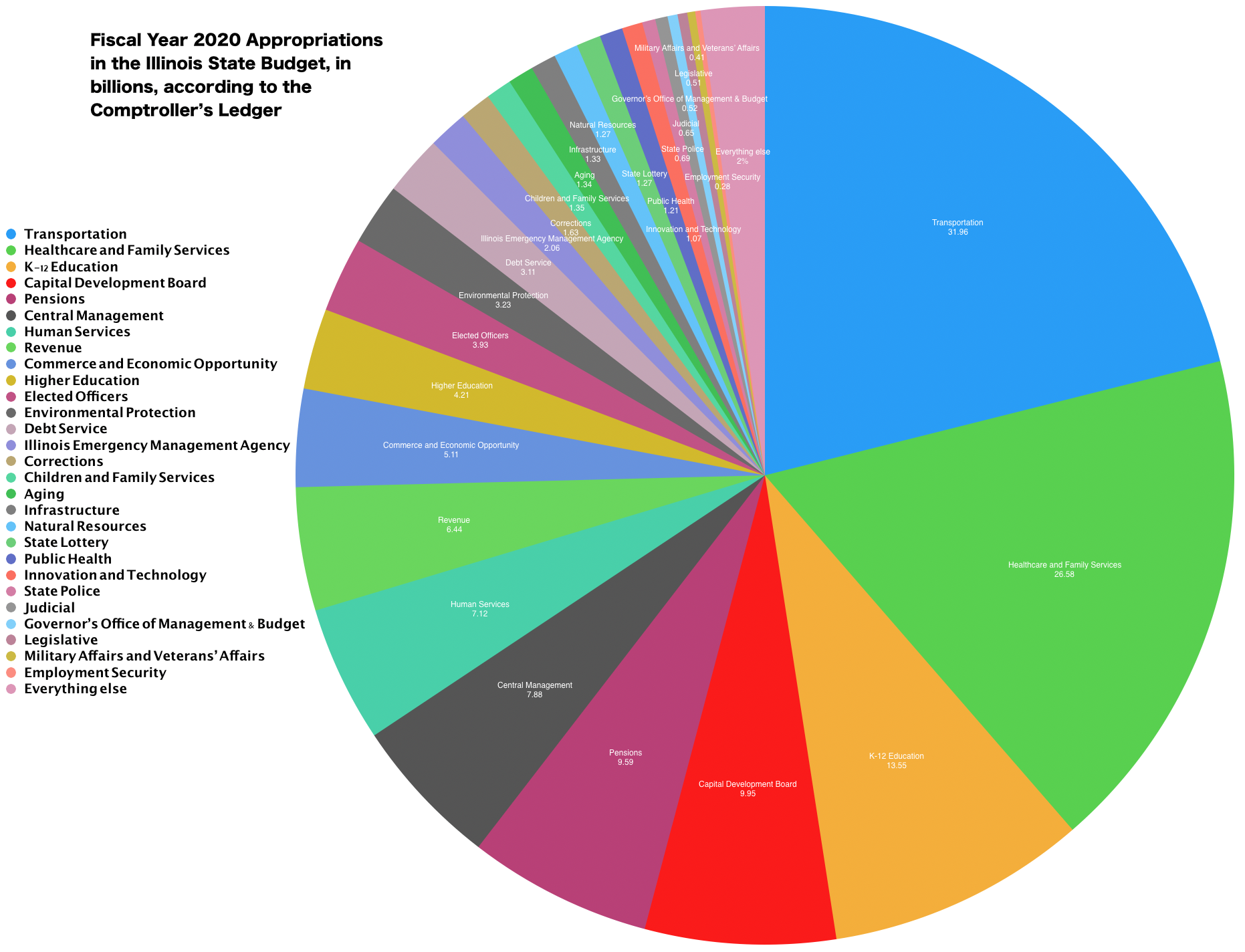
I’ve spent several hours studying the Illinois State Comptroller’s website.  It has not been designed in a way that helps the public understand the big picture of where money goes.  I have taken figures from the FY 2020 allocations to create this budget picture of state budget allocations:

A pie chart with many brightly colored slices representing allocations of public money in the Illinois State Budget.
The Illinois Public Outlays in FY2020

I think this chart is based on outlays that include money that is not raised through Illinois revenue; that is, it represents state spending that comes from state sources and state spending that is allocations of federal dollars given to the state. So, other charts showing spending might only show spending of funds that are in general revenue funds or dedicated funds that accumulate from Illinois sources (like taxes on gasoline or marijuana, or fishing and hunting licenses, and so forth). 

Oddly enough, the Transportation budget was reported as being $32 billion, the largest item in the budget.  I think this was an exceptionally large amount, due to a capital improvement bill getting passed, so in normal years that would have been significantly less. Likewise, the capital development board had $9.6 billion appropriated to give out for construction projects and renovations. 

Healthcare and Family Services, which is mostly payments to doctors, hospitals, pharmacies, dentists, and so forth, made through health management organizations, using Medicaid funding (the state gets about half the money back from the Federal government in Medicaid spending), was the next largest item, and in years without a capital improvements act, it would be the largest item, at $26.6 billion.

K-12 Education was the third largest allocation from the state, at $13.55 billion.  There is also money raised at the local level through property taxes, so the state and local combined spending on education is much higher.

Illinois has not adequately funded pensions for state employees, but that is a priority now, and $9.6 billion was allocated for pensions.

Central Management had a budget of $7.88 billion.  Nothing on the Comptroller really explained that.  There needs to be more useful information for average citizens about some of the budget items.  I think the Comptroller ought to do a better job.

Human Services had a budget of $7.1 billion. Some of that is federal money that just passes through the state government, like Women and Infants and Children programs ($0.394 billion). One of the largest items in the Human Services budget is the $1.257 billion for Community Based Services for Persons with Developmental Disabilities and for Intermediate Care Facilities.  Mental health grants and program support were at $0.303 billion, but probably ought to be funded at over $1 billion.  Grants associated with Child Care Services were $0.402 billion. Those probably ought to be closer to $0.8 billion.

The Department of Revenue had appropriations of $6.44 billion, and much of that was in the form of tax refunds.  I think that would include the Illinois State Earned Income Tax Credit, but the Comptroller’s ledger didn't break that down.  

   Commerce and Economic Opportunity had $5.11 billion.  I hope much of that money goes to investments in low-income communities, or state investment in training people to start worker-owned cooperatives and other forms of democratic capitalism.

  Higher Education had allocations of $4.2 billion.  Not nearly enough.  It ought to be at least $6 billion, and probably much more even than that.

Environmental Protection had a budget of $3.23 billion.

Our state has not had a balanced budget in quite a while, and service on our debt cost the state $3.1 billion.

Children and Family Services (child protection services, foster care, adoptions, and that sort of thing) had appropriations of $1.35 billion.  Probably $1.5 billion is more like what we need.

Corrections had a budget of $1.6 billion, but that does not include the budgets for county and city jails, which probably had a similar cost, if not possibly more in aggregate, but that cost is paid by local sales and property taxes for the most part.  Still, the accusation that the “the state spends more on locking people up than educating them” is ridiculously false, as our state education budgets for K-12 and higher education are in excess of $17.7 billion before even factoring in local spending on schools and junior colleges.  Even if county and local jails cost twice-as-much as the state prison system, we would still only be spending $3.8 billion on locking people up. 

The Department on Aging only had appropriations of $1.3 billion.  That will need to go up as the state ages.

Elected Officers had a budget of $3.9 billion.  I do not understand what that represents.  I suppose it includes pensions as well as salaries for elected officers, but that is not just the governor and elected state officials (e.g., the Comptroller) plus all the members of the Illinois General Assembly, is it?  It must include their staff members as well, I suppose.  But, there is also a budget category for the legislature, and that is $0.5 billion ($500 million), which seems enough to pay for lots of legislative staff. 

The idea that we ought to de-fund the police to support mental health services and alternative approaches to non-violent and nuisance crimes may make sense at the level of local budgets in cities and counties, but at the level of the state government, Illinois puts up $69 million for the State Police.  While I think mental health services should be increased substantially, I do not think the money required to meet our needs could be found in a budget item that is only $69 million, when we need $1,500 million more for mental health and substance abuse prevention/treatment, in my opinion.

Anyway, that is an overview of the appropriations for the State of Illinois budget as it was last year (FY 2020 ended on June 30 of 2020, and we are now in FY 2021).  If these numbers are wrong, blame Susana A. Mendoza, our Comptroller. She may not think it is the duty of her office to explain the budget or give the public reports that show how the state spends its money so that common people can understand it (I have a doctorate and have studied public policy and economics, and even I was confused by the information on the website). Perhaps that is what the Treasurer or the Governor should do.  I often rely on people like the staff at the Center for Tax and Budget Accountability to explain the budget.  Rich Miller and Charlie Wheeler also help us understand.

Monday, April 30, 2018

Student accepts state funding for abortions in some cases, but doesn't want state funding for all abortions


Dear Senator Righter,

As you know, I am a constituent in your district from Teutopolis. We have talked before – you helped in my past internship at Illinois Policy, and I’m sure your previous aide, Judy, has told you about my recent internship in Washington D.C. I am a Social Work major at the University of Illinois Springfield, and I wanted to bring your attention to a bill that I believe you should vote no to.

HB 40, Access to Abortion, is a bill that provides taxpayer funded abortions to all women in Illinois, including those on Medicare and state employee’s insurance plans. Currently, the state only provides funding for abortions in cases such as rape, incest, and to protect the mother’s life. The bill also ensures that abortion will be legal in Illinois even if the federal government repeals Roe v. Wade.

I believe that this bill should not be passed for multiple reasons. Though I am conservative, I am pro-choice. I believe that women should be able to choose what is best for their lives and their bodies. However, I disagree with this bill. First, this bill would cost Illinoisians millions of dollars, millions of dollars we do not have and cannot afford. In 2015, there were nearly 40,000 abortions in Illinois, and if abortions were free, it is proven that even more women would get them. Currently, abortions cost about $1,650. That would amount to millions of dollars of further debt that the state cannot afford.

I agree that in rape, incest, and mother safety cases, abortion can be payed for by state tax dollars because that was not the woman’s decision, but in other situations, that should not be the case. It is not hard to not get pregnant. Plan B is around $30-$40, male and female condoms are a few dollars. Abstinence is free. Because of the Affordable Care Act, many women’s birth control is free or inexpensive. We should not provide free abortions to everyone because they find it too difficult to buy protection, “condoms don’t feel good”, are careless with their birth control, or do not have the education to understand how to not become pregnant.

When a woman chooses to have sex and not protect herself from pregnancy, the only person at fault is her and the man. It should not be the job of her fellow citizens to bail her out of the problem she put herself in. Senator Righter, please vote NO to HB 40.


My comment on this excellent example of a policy advocacy letter is that it is refreshing to read an opinion on this issue that is nuanced and takes a stand based on ideals of fiscal responsibility and personal responsibility.  So often any policy advocacy related to abortion is entirely one-sided with an extreme stand totally against nearly all abortions and state funding for abortions or else totally in favor of policies to make abortion accessible to all, including those who can’t afford it.  Another thing that I find interesting is that you hardly even touch the moral issues related to “rights of unborn children” or “rights of the mothers to control their bodies.”  You dispose of that right at the start with a statement about your general opinion that abortions ought to be a women’s matter of choice, but when it comes to the public funding them, the public purse ought to facilitate abortions only in the three rare extremes (life of the mother, rape, and incest).  The letter is also a good example because of its elegance and directness.

A few points just for us to think about, that are really not about the letter itself:

1) If someone wants to make abortions free for all those who want them, they can create a charity and fund abortions for poor women.  Let the advocates for accessible abortion provide them through private means.

2) What about the case of unborn children who are severely malformed or unhealthy, so that a doctor predicts they may perish within hours of birth; could that situation be added to the standard categories of rape, incest, and health-of-the-mother?

3) What about cases where the unborn children have a reasonably good chance of survival, at least for a matter of years rather than hours, but are likely to be in need of intensive medical intervention throughout their lives, and are also likely to be so profoundly disabled that they present a tremendous potential burden on the society and the family?  In those cases, can financial considerations be taken into consideration, and should the state fund abortions to save money in the long run? 

4) And, what about the moral issues?  If the state is going to fund some abortions in special cases, can anything be done to address the objections of those who feel so strongly that abortion is akin to murder?  It is normally accepted in a democracy that when you fulfill your duties as a citizen and pay your taxes, you understand that some of that money you’ve contributed will go to fund things you strongly object to (I object to a wide range of things done in my name by my government with my tax dollars, especially the killing of many innocent people with our careless, callous, and cruel arial bombardments from drones and so forth). But, is abortion a special case, where the opponents are so deeply morally offended by the act that the government should fund those special case abortions only with a special source of funding that some persons could refuse to pay?  Perhaps it could be handled in a way similar to federal funding for elections, where taxpayers check a box to agree to contribute some of their tax contribution to support public funding of elections.  


The four points I raise were correctly ignored in the letter; I just offer them to provoke some thought and debate.

Wednesday, May 2, 2012

No Kid Hungry Campaign


Here is a student essay describing a policy or program. 

On March 14, 2012, Governor Patrick Quinn announced a new partnership in efforts to end childhood hunger in Illinois. A 2011 report from Feeding America found that more than 745,000 children in Illinois are at risk of hunger. Families are struggling to put food on the tables and provide nutritious meals. The organizations, Share Our Strength and Illinois Commission to End Hunger gathered at Parker Elementary Community Academy in Chicago to announce the Commission’s report and start off the Illinois No Kid Hungry campaign. The campaign will work to help teach more families about federally funded programs to help assist in hunger needs such as; school breakfasts and summer meals which provide children with a healthy start they need. They will also help families learn how to cook healthy yet affordable meals for their families. Share Our Strength and the Greater Chicago Food Depository have joined together to begin the Illinois No Kid Hungry Campaign. With the help of their sponsors; Jimmy Dean, Walmart, Arby’s Foundation, and supporter- Weight Watchers, Illinois will soon be looking at a shrinking number of children who are hungry.
Any school that is a public school, nonprofit private school, or a residential child care institution can choose to take part in the School Breakfast Program. More than 770,000 students are eligible for the free or reduced breakfasts and lunches at school, yet less than one half of the students are participating in this program. This means children are coming to school hungry because there is not enough food to eat at home. Hungry children are less likely to perform to their highest potential in the classrooms. Also, less than 15% of the children who are eligible for the summer meals receive them. Illinois is actually in the top five states that have actually lost federal funding due to low participation rates for these services. The young children of our communities need good nutritious meals in order to grow physically and keep up with their academics to their full potential. Through the help from Share Our Strength, children who are in need will be enrolled in federal nutrition programs and families will be taught how to cook healthy and affordable meals. The families will learn how to select nutritious, yet low-cost ingredients and prepare meals in ways to ensure the best nourishment for their family.
 With the help from Illinois Commission to End Hunger and No Kid Hungry students and their families will be better aware of the programs available. With the generous help from numerous not-for-profit programs, the people of Illinois can receive help without using any state money or without raising taxes. This is a big relief that the state is not going further into debt with this Commission to End Hunger program. Share Our Strength and No Kid Hungry campaigns in 16 other states besides Illinois. These states include Maryland and Colorado, where it has been an incredible success. In Maryland, this campaign has helped to increase the number of children eating summer meals by 7.5%. In Colorado, has increased the participation in school breakfast program by 430,000 more meals served. It looks like Illinois is on the same road to success as these other states are to end hunger for the children.

Thursday, April 7, 2011

Illinois General Revenue Spending in Fiscal Year 2011

I was just looking at the expenses report from the Illinois Comptroller, and I made this pie chart to show some projections of where the state's general revenue fund money is being spent in FY 2011.

An appeal to the governor from a student


A student in my class wrote this letter to our governor: 

Dear Governor Quinn

I’m writing to ask you to change your mind about making cuts of up to five hundred million dollars in the area of human services. Now, I understand that the state is in debt and cuts have to be made, but why must the majority of the cuts be in human services? If the cuts were more evenly distributed among all areas then maybe such a devastating blow won’t be dealt to human services
By cutting funds to human services there are greater strains to individuals, children, families and communities at a time when they are already struggling and need help. Too many cuts can lead to a dismantling of the security net of treatment for Illinois citizens with mental illness and developmental disabilities, people caught in the trap of addiction to drugs and alcohol, and persons in need of domestic violence services. These cuts will add to the loss of family job supports, which includes child care assistance, day care programs, and after school programs, that help to support working parents and also are a benefit to the children involved. Another important factor is a loss of jobs. The human service sector is a major employer in the state of Illinois. And unpaid bills and budget cuts have caused lay-offs or have shut down agencies. Doesn’t it make more sense to help people before they’re past the point of help, and end up committing crimes to support their families or continue on with their addictions? By having these services available, we can help people to better themselves and their lives and this could lead to a greater future for Illinois. 
In closing, just remember how much this will impact our most vulnerable populations in Illinois. How would you feel if you or someone you know needed one of these services and couldn’t receive them because they no longer exist, or you were turned away because they have reached the maximum limit possible. Imagine being scared and alone with no one and nowhere to turn to for help. Now keep this feeling in your mind because this is how many Illinois citizens will feel for many years to come if the majority of budget cuts fall onto human services.

Monday, February 8, 2010

Nice post about the state budget.

I enjoyed this post from PeoriaStory about the Illinois budget. Another article here at the Peoria Journal Star explained the budget problem's implications for higher education.

One thing I don't understand is why the Comptroller's Office says in this fiscal year (which is in its eighth month now) that $1.9 billion has been given to higher education, including, according to the Comptroller's website, $583,369,628 to the University of Illinois (leaving only $184,417,870 unexpended). If the state has given $583 million to the University of Illinois and only has $184 million left to give, then how can it be true, as we're told, that the state is way behind on its funding for the U of I. We're being given (temporary) pay cuts and the reasoning is that since the Illinois State hasn't given the money allocated to the University, therefore we must make these sacrifices to get by. And yet, according to my understanding of what the Comptroller's Office claims, the University has had much of it's allocation expended. So, what happened to the $583 million supposedly given to the University of Illinois for FY 2010?

- Eric

Tuesday, March 3, 2009

Understanding politics and Truth over Happiness.

Jodie Allen and Richard Auxier of the Pew Research Center have put up an article at the Atlantic Monthly's online site about how the public receives messages from the president.  This article gives some excellent insights into how the public respond to a president's speech or press release.

The article makes a reference to "Happy Talk," which will hopefully call to mind the scene and song from the musical South Pacific.  An apt use of a cultural reference if ever I saw one.

Thursday, February 5, 2009

State Budget Deficit is 9 billion?

There's a good article about the Illinois state budget deficit at the Journal-Register. Dan Hynes has been warning about a shortfall for months, but before this week I had never heard that he warned we could face anything like a $9 billion deficit. 
In a related note, the Capitol Fax blog discusses some of the politics around the state budget deficit and federal politics. 
Dan Hynes has a pretty good webpage for the Comptroller where you can read about budget issues related to various policies.