Showing posts with label budget. Show all posts

Monday, October 19, 2020

The Budget of the State of Illinois


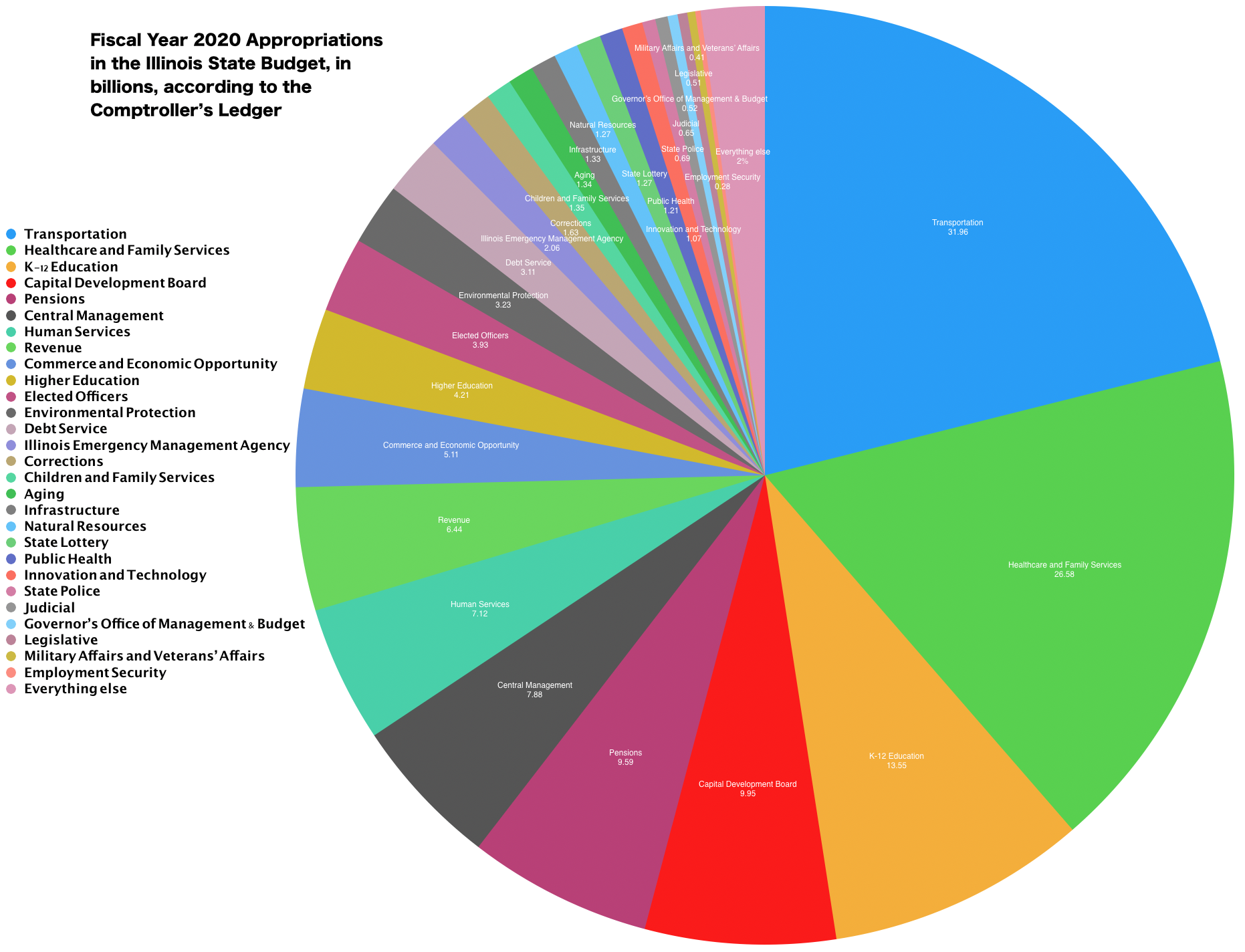
I’ve spent several hours studying the Illinois State Comptroller’s website.  It has not been designed in a way that helps the public understand the big picture of where money goes.  I have taken figures from the FY 2020 allocations to create this budget picture of state budget allocations:

A pie chart with many brightly colored slices representing allocations of public money in the Illinois State Budget.
The Illinois Public Outlays in FY2020

I think this chart is based on outlays that include money that is not raised through Illinois revenue; that is, it represents state spending that comes from state sources and state spending that is allocations of federal dollars given to the state. So, other charts showing spending might only show spending of funds that are in general revenue funds or dedicated funds that accumulate from Illinois sources (like taxes on gasoline or marijuana, or fishing and hunting licenses, and so forth). 

Oddly enough, the Transportation budget was reported as being $32 billion, the largest item in the budget.  I think this was an exceptionally large amount, due to a capital improvement bill getting passed, so in normal years that would have been significantly less. Likewise, the capital development board had $9.6 billion appropriated to give out for construction projects and renovations. 

Healthcare and Family Services, which is mostly payments to doctors, hospitals, pharmacies, dentists, and so forth, made through health management organizations, using Medicaid funding (the state gets about half the money back from the Federal government in Medicaid spending), was the next largest item, and in years without a capital improvements act, it would be the largest item, at $26.6 billion.

K-12 Education was the third largest allocation from the state, at $13.55 billion.  There is also money raised at the local level through property taxes, so the state and local combined spending on education is much higher.

Illinois has not adequately funded pensions for state employees, but that is a priority now, and $9.6 billion was allocated for pensions.

Central Management had a budget of $7.88 billion.  Nothing on the Comptroller really explained that.  There needs to be more useful information for average citizens about some of the budget items.  I think the Comptroller ought to do a better job.

Human Services had a budget of $7.1 billion. Some of that is federal money that just passes through the state government, like Women and Infants and Children programs ($0.394 billion). One of the largest items in the Human Services budget is the $1.257 billion for Community Based Services for Persons with Developmental Disabilities and for Intermediate Care Facilities.  Mental health grants and program support were at $0.303 billion, but probably ought to be funded at over $1 billion.  Grants associated with Child Care Services were $0.402 billion. Those probably ought to be closer to $0.8 billion.

The Department of Revenue had appropriations of $6.44 billion, and much of that was in the form of tax refunds.  I think that would include the Illinois State Earned Income Tax Credit, but the Comptroller’s ledger didn't break that down.  

   Commerce and Economic Opportunity had $5.11 billion.  I hope much of that money goes to investments in low-income communities, or state investment in training people to start worker-owned cooperatives and other forms of democratic capitalism.

  Higher Education had allocations of $4.2 billion.  Not nearly enough.  It ought to be at least $6 billion, and probably much more even than that.

Environmental Protection had a budget of $3.23 billion.

Our state has not had a balanced budget in quite a while, and service on our debt cost the state $3.1 billion.

Children and Family Services (child protection services, foster care, adoptions, and that sort of thing) had appropriations of $1.35 billion.  Probably $1.5 billion is more like what we need.

Corrections had a budget of $1.6 billion, but that does not include the budgets for county and city jails, which probably had a similar cost, if not possibly more in aggregate, but that cost is paid by local sales and property taxes for the most part.  Still, the accusation that the “the state spends more on locking people up than educating them” is ridiculously false, as our state education budgets for K-12 and higher education are in excess of $17.7 billion before even factoring in local spending on schools and junior colleges.  Even if county and local jails cost twice-as-much as the state prison system, we would still only be spending $3.8 billion on locking people up. 

The Department on Aging only had appropriations of $1.3 billion.  That will need to go up as the state ages.

Elected Officers had a budget of $3.9 billion.  I do not understand what that represents.  I suppose it includes pensions as well as salaries for elected officers, but that is not just the governor and elected state officials (e.g., the Comptroller) plus all the members of the Illinois General Assembly, is it?  It must include their staff members as well, I suppose.  But, there is also a budget category for the legislature, and that is $0.5 billion ($500 million), which seems enough to pay for lots of legislative staff. 

The idea that we ought to de-fund the police to support mental health services and alternative approaches to non-violent and nuisance crimes may make sense at the level of local budgets in cities and counties, but at the level of the state government, Illinois puts up $69 million for the State Police.  While I think mental health services should be increased substantially, I do not think the money required to meet our needs could be found in a budget item that is only $69 million, when we need $1,500 million more for mental health and substance abuse prevention/treatment, in my opinion.

Anyway, that is an overview of the appropriations for the State of Illinois budget as it was last year (FY 2020 ended on June 30 of 2020, and we are now in FY 2021).  If these numbers are wrong, blame Susana A. Mendoza, our Comptroller. She may not think it is the duty of her office to explain the budget or give the public reports that show how the state spends its money so that common people can understand it (I have a doctorate and have studied public policy and economics, and even I was confused by the information on the website). Perhaps that is what the Treasurer or the Governor should do.  I often rely on people like the staff at the Center for Tax and Budget Accountability to explain the budget.  Rich Miller and Charlie Wheeler also help us understand.

Sunday, May 10, 2020

An advocacy letter recommending huge increases in child care support


Child Care and the Workforce
I am writing today to bring your attention to an important matter. Wanting the best for your child’s safety, care, and wellbeing is the number one priority in any parent’s mind. Unfortunately, “The United States is among the lowest in the developed world in the early childhood care we provide” (Friedman, 2014). Parents need comfort and consolation that their children will be well taken care of when going to their jobs. Parents should be able to trust that their country’s expectation and standards for childcare, regardless of the city and/or state, are more than satisfactory. To many parents’ dismay, the childcare system in the United States is below subpar. 
Though Americans spend more on childcare than in other developed countries (and those countries actually provide excellent childcare), “the majority of American day care providers ranked fair or poor and only 10% were deemed of high quality” and “the cost of care has doubled since the 1980s, according to the Census Bureau” (Friedman, 2014). Many parents have been stopped or greatly restricted in their careers due to their need to parent their children because of the great lack of decent childcare. A recent study published in March 2019, examined a group of about 2,000 Amazon employees with younger children and “argues that a lack of affordable childcare has prevented talented women from progressing in their careers” and “these mothers are ‘tired of seeing colleagues quit because they can’t find childcare’” (Schochet, 2019). Amazon is typical of American workplaces. Parents nationwide have struggled with this for too long.
Our lack of good childcare forces many parents to leave their jobs due to needing to take care of their children. There’s also an increase in one parent working and the other staying home to be a full-time caregiver and not even working with the degrees that they’ve earned to fulfill life-long dream careers. To make matters worse, good quality childcare is expensive, especially when having multiple children. Fortunately, all hope is not lost for these parents.
The two largest federal programs that provide free or subsidized childcare are The Child Care and Development Block Grant (CCDBG) and Head Start (HS). These federal programs are made for low-income families and parents who are still trying to pursue their careers with younger children. The CCDBG is the biggest monetary source of federal funding for childcare assistance. It funds childcare subsidies provided by states for low-income families. The other federal program, Head Start, helps to ensure that children get high quality early education in addition to health and social services (Schochet, 2019). 
These programs need more funding. They need to be able to help more families. They’ve made such an impact and helped so many families, but more families need such assistance. Approximately one million low-income children and their families are helped annually, but in 2018 over four million persons lived in poor families with related children under age six (Semega et al., 2019, Table B-2). Though these programs have helped many families through “promoting maternal labor force participation” and have been having “positive child outcomes” (Schochet, 2019), they need to include more families in their served population, and need the funding to be able to do so. Many more families and parents need this assistance. Sadly, “only a small portion of families who need assistance paying for childcare receive it...about one-third of eligible 3- to 5-year-olds, while Early Head Start serves seven percent of eligible children under age 3” (Schochet, 2019).
In conclusion, a very select amount of families receive assistance with childcare and so many more need it. Please help support and help these families that are in need. Parents are struggling and unable to fully fulfill their responsibilities and duties, and children are suffering in poor quality childcare facilities and not receiving the appropriate attention and care they deserve. Recently, in the FY 2020 budget, the Federal government appropriated $7.7 billion for the CCDBG and $11.6 billion for Head Start (Joughin, 2019).  It seems to me a more appropriate level of funding would be $20 billion for CCDBG and $35 billion for Head Start.
References

Friedman, S. D. (2014, August 7). 7 Policy Changes America Needs So People Can Work and Have Kids. https://hbr.org/2013/11/7-policy-changes-america-needs-so-people-can-work-and-have-kids 

Joughin, C. (2019). Here’s the latest on federal funding for early learning and care for FY2020. First Five Years Fund. https://www.ffyf.org/heres-the-latest-on-federal-funding-for-early-learning-and-care-for-fy20201/

Schochet, L. (2019, March 28). The Child Care Crisis Is Keeping Women Out of the Workforce. https://www.americanprogress.org/issues/early-childhood/reports/2019/03/28/467488/child-care-crisis-keeping-women-workforce/ 

Semega, J., Kollar, M. Creamer, J., & Mohanty, A. (2019). Income and Poverty in the United States: 2018. U.S. Census Bureau. https://www.census.gov/content/dam/Census/library/publications/2019/demo/p60-266.pdf

Wednesday, April 25, 2018

Education needs more support and emphasis, and so does policy


 Before taking this class, I had almost no interest in advocacy and the idea kind of annoyed me, even though I knew it would be important for me to advocate for my future clients. Since being involved in the class this semester, I have started to develop a deeper understanding and interest in advocacy related topics. For one, I am looking forward to attending the advocacy day at the capital. I think it will be a great look into advocacy in action. This course has challenged me to keep updated on current events and to know what is happening in policy. Growing up, I have been so used to completely ignoring anything political going on, since it did not directly pertain to me. 

Another thing that is interesting to me about policy is how if you look under the initial statement or claim that the press, media, or government make, there is usually something deeper going on underneath. In class we talked about Trump’s idea to give drug dealers the death penalty, and how his staff and colleagues sort of supported him in that, using guarded language. But, the reality behind that was that the law does not allow the death penalty for drug dealers who do not kill anyone. 

Education policies are also something that interest me greatly. When I started college I was an education major, and a big reason why I left that major was because I couldn’t stand the laws and government influence in the system. I decided I would much rather help people on an individual level than have to deal with common core and school budget cuts. I have seen recently in the news and on Facebook a lot about teachers with run down classrooms that are falling apart. These teachers complain that they do not have supply budgets and have to spend their own money on copy paper in order to print off worksheets for their students. Teachers believe they shouldn’t have to worry about their budget crisis and should be focused on their students, and I have to agree. I think it is interesting and frustrating how we discuss in class how much of the United States budget is spent on the military. Even a small fraction of that budget would significantly help the education system in the United States. I am hoping that after all this uproar on social media, we start to see some better education policies written. 


Yes, state and federal budgets are moral documents. They represents what we think is important.  It’s true that state taxes such as sales and property taxes don’t fund the military, and none of the payroll taxes fund the military, but when it comes to the Federal Income Tax, about half of that is going to national defense, or, if you prefer the term Karl Marx used: “The Human Slaughter Industry.”  Obviously we need some national defense spending and we need some persons to serve in the armed forces, and there are many noble and good persons in the military, but it is discouraging to read about American rockets and bombs killing innocent people in Yemen, Syria, Afghanistan, and so forth, and likewise disheartening to read about the huge profits made by companies that produce and sell such weapons and encourage their use, or sell over-priced and low-quality equipment and material to the armed forces; meanwhile, as you point out, we have not invested adequately in schools.  And, the media and our pervasive paranoid culture remain fascinated with “welfare cheats” and people who “abuse the system” by getting a few hundred dollars per month of food or rent subsidies that someone begrudges them.  Meanwhile, we give contracts to timber and mining and ranching interests to pay the public mere pennies on the dollar for the resources they take from our commons (public land); we continue to subsidize unsustainable and unethical industrial farming, destructive fossil fuel consumption, and the prison-security industrial complex.  Yet in the testimony about investing a few hundred thousand dollars to help young adults who have aged out of foster care to go to four-year colleges, many state representatives apologized (apparently sincerely) that there was “no money left” [sic] to fund such extravagances. 

Humans brutalized by the system that squeezes them into conformist roles in making other people wealthy while supporting a parasitic leisure class of “creators” whose main contribution to society is raiding companies and stripping them of value and putting their workers into unemployment are shielded from the truth, and their wounds and disappointments and stresses make some of them susceptible to sadistic fantasies of “killing the brutes” (whether fantasizing about running your car over a Black Lives Matters protestor or actually committing genocide against plantation workers in the Belgian Congo, Europeans and European-Americans have an enduring ability to turn their own pain into the infliction of misery on others). The imagined spectacle of executions of drug dealers, or the heartless deportation of Americans who happened to be born abroad and arrive here as small children, or the the imposition of long prison sentences on poor persons who commit petty crimes (20 years incarceration a potential sentence for trafficking your SNAP benefits)—these are the fantasies of a people who are corrupted by an immoral system of exploitation and false competitive struggle. The work of our profession to change the culture and change the debate and encourage new priorities and more effective solutions to social problems is daunting but absolutely necessary. 

The struggle to get people to see how immoral and inefficient and wasteful our current priorities and policies are is one that can be so challenging that we can get discouraged. But, it is not a hopeless struggle, and sometimes there are successes.

[The “killing the brutes” phrase is a reference to Joseph Conrad’s novel Heart of Darkness, in which the insane Kurtz adds the phrase “exterminate all the brutes” to a report he has submitted to a group intent on the suppression of savage customs.  And, if you read Adam Hochschild’s King Leopold’s Ghost you will know that the Belgian administration in the Congo did kill millions of Africans, just as the fictional Kurtz recommended. My point is that people go mad in extreme conditions, and it is madness to fantasize about killing nonviolent protestors, just as it is madness to tolerate policies that kill innocent people, like a health care system that lets people die if they don’t have the money to pay for life-saving medicines or procedures that society could easily afford to provide, or a “defense” system that routinely kills innocent people thousands of miles away from us who are minding their own business and have no animosity toward us until our bombs (or the bombs of our so-called “friends”) smash up their homes and break the bodies of their friends and family.]

Wednesday, April 27, 2016

Cuts in social welfare spending are harmful

There are opposing views on social welfare.  Not one person is right about the definition or ideology of social welfare. Social welfare programs have grown, shrunk, stabilized, and declined over the years.  Many want to eliminate programs because they think that millions are taking advantage of them.  The sad part is that thousands need these social welfare programs to survive.  

As a social worker there will be obstacles and clients that will make things difficult, but a great social worker will gather those resources to help clients reach their goals.  The majority of government officials and the general public feel that the majority of people on public aid are taking advantage of the programs. What is interesting is that the general public, who once were part of the middle class find themselves in the same situation as the poor and they may now understand that there are some who need those welfare programs   

  If they do get rid of welfare programs, where will these people receive assistance?  This is dehumanizing the life of another human.  This bothers me and I want to get others to understand that not all recipients of welfare programs put themselves there.  Our own country did this by eliminating jobs and outsourcing to foreign countries to save money. Groups of people need to be educated and learn that some people do not want to be on these programs but circumstances play a role.  

I strongly believe that government intervention is necessary in order to control and regulate social welfare while keeping ethics in mind, but at the same time, it is not necessary for everyone. People have the ability to change their lives for the better with hard work and dedication, but I also know that in some cases that people cannot help themselves or get ahead regardless of how hard they work.  They need the assistance to get by.

So far, there have been several topics talked about in class that affect me personally. Poverty and discrimination affect me directly and I can empathize with others in similar situations.  Being a social worker will be a difficult job, struggling to find the necessary resources out there to better help clients that I will come into contact with.  Cuts in funding have affected all the areas of the economy, especially education and social welfare programs that affect the poor, disabled, and others who have lost jobs, homes, and families.  

  Simply getting into college is a challenge for everyone. The difficulties do not end once you have received that much hoped for college acceptance letter. The truth is that many students with skills, qualifications and a desire for a college education are stopped short in their quest for knowledge and better employment opportunities by the high costs of tuition and student living expenses. Unless a tuition-needy student wins the lottery, his or her most realistic options for getting a college education are interest-consuming college loans or scholarships. Most scholarships are difficult to find or they do not apply to certain groups of people.  One of my biggest problems with education is that our government wants to give free education to immigrants, but most are here illegally and I struggle with the fact that they are offered a free education when one of my children has loans and no job to pay them back.  

In response to this financial need, many corporations, government agencies and civil groups have instituted scholarship programs that give students more of a fighting chance in the high competitive race for financial aid. This aid is going to be affected by the education funding cuts. These cuts would decrease the number of professionals that are going to graduate in the future, which at the same time would affect the technological and scientific growth of the country, fields in which the United States holds first place in the world. Also, this reduction in education funds would reduce the options for young people making them even more confused about what life has to offer them and what they can do in the future. In some cases this situation can confuse the student so much, putting them in a situation which can destroy their view of the American Dream.  But, even in today’s society having a college degree does not guarantee a job in these economic times.  I think the schools should look at the careers that are promising and offer degrees that can potentially lead to a job.  There are many degrees that are offered through many colleges that do not pertain to any job that is out there, leaving millions of students with loans that they cannot pay back.  Colleges need to stop giving out degrees that will not land a student a job after they have worked so hard.  This type of scenario leads young adults down a path of destruction, possibly depression or other destructive things in their lives which could potentially put them in a social welfare program that also is being affected by cuts within our local, state, and federal governments.


Cuts in social welfare programs are affecting other people like children, seniors, the disabled, mental patients who cannot do anything to support themselves. This will create bigger problems, because we would have more homeless people and more crime, pushing the economy to fall even more. All this together would decrease the standard of living of the country and would leave a very difficult situation for future generations. There are ways to fix the state of Illinois’s budget issues if everyone would work together to make a better situation for everyone involved.

You make a very important point when you observe that people prefer not to receive assistance.  Surely 96% to 99% of all adults would rather be self-sufficient and independent with their finances while enjoying a decent life compared to the alternative of needing to rely on the charity of others or government programs to provide them with the resources to survive.  The question is what prevents people from being independent and self-sufficient.  Some people have disabilities or health problems or mental health issues or developmental disabilities that would make it difficult for them to be financially independent, but policies can enhance their autonomy.  Also, on one hand, we probably expect too little of many people with these problems, and we fail to create workplaces or economic roles where such persons could thrive and contribute.  Yet, on the other hand, we are also probably guilty of sometimes expecting too much, and demanding things of persons when there is no reasonable way for those persons to meet the expectations we place upon them. 

   Among those who are dependent, some will have developmental disabilities or physical disabilities that would make it difficult for them to find employment, but we are making progress in finding ways to remove barriers and prejudices and human-imposed limitations on many persons with disabilities or developmental issues.  Others in the population of persons who are dependent probably cope with serious health problems or severe mental health problems that make economic productivity difficult or impossible for them.  It is generally a good idea to help these people feel they are contributing, and help them to get routine in their lives, and give them things they can accomplish, or ensure they have opportunities to have meaning in their lives.  Yet, it may be the case that the free market doesn’t provide such things, and we may need to be creative and find ways to include persons with such problems in our economic life without giving them a sense that they are parasitical or worthless simply because they don’t make significant economic contributions. 

Others who are dependent may have personality disorders, or addictions, or other behavioral issues that make it difficult for them to find and hold a job. For these people we ought to have treatments to help them change and become healthier and enhance their functioning, and until we provide such services, many of these people will not be able to thrive in the labor market, and they will be dependent.  Most people who are dependent on welfare are just going through a phase in their lives where they are temporarily down and poor.  They will naturally work their way back into more prosperous circumstances, and their temporary dependence should really be of no concern to us.  Naturally there will also always be a group of unemployed persons who would be employed if we created an economy with full employment, but our free enterprise system depends on their being a threat of poverty and destitution as a spur to make workers accept bad jobs with low pay, so there will always be healthy and capable people who can’t find work, and temporarily need help while they continue looking for some way to get back into the economic life where they can earn their livelihood.  Finally, there must be a group of persons who are sturdy and healthy and quite capable of functioning well, and they could work, but they refuse to do so, and prefer to use the welfare system. But how many of the dependent Americans really fall into this category?  I think if we guessed 2% or even 1% we would be exaggerating their numbers by at least tenfold. 

Once people see things as you and I do, they will hesitate to cut welfare and human services.  As things stand now, there is a narrative of moral deviance and the poor.  People who use welfare programs are dehumanized and described as reprehensible and lazy.  

But one thing I’m not so certain of is your claim that universities must cease offering degrees that lack vocational direction.  Certainly vocational training has its place in higher education, but colleges are not tools of the capitalist system with a function of producing good workers.  Rather, universities produce citizens, scientific research, gains in knowledge, and graduates who have a set of skills and moral frameworks that ought to make them better people.  They ought to have improved their communication and thinking skills in ways that will make them better friends, better family members, better citizens, better neighbors, and also better workers.  Most college students will probably not find employment in a field closely related to their major or academic concentration, and that is fine.  

Tuesday, April 26, 2016

MAP grants are not getting adequate funding


For my second reaction paper, I will be discussing my feelings on the lack of MAP Grant funding in Illinois for the 2016-2017 school year.  The 2016-2017 school year is supposed to be the year I graduate with a Bachelor’s Degree in Social Work.  As a MAP Grant recipient, I am absolutely terrified that, because of the budget impasse in Illinois, MAP Grants will not be funded for the next school year. 

The Senate, House, and Governor Rauner have yet to come to an agreement on a state budget as of this writing.  Because of this, many social service agencies have closed, countless people have become unemployed, public universities are in jeopardy of shutting down without funding. It would be easy to construct a vast list of other negative effects of the budget impasse.  It is my understanding that Governor Rauner has proposed a state budget that would ultimately give him the ability to decide to move money around to different services as he deems necessary.  Of course, the House and Senate will not agree to this as giving control to Governor Rauner removes their own control of the state’s money allocation.  

Many attempts have been made to create a budget that is a suitable compromise for the branches of government previously listed.  However, each of these proposals have been rejected, still leaving us without a budget nearly nine months into the fiscal year.  While I had been following the budget crisis, it had not personally affected me until Governor Rauner vetoed a bill to fund MAP Grants.  

I have no idea if I will be able to finish my schooling next year.  I do not feel comfortable taking out even more students loans than I currently have to finish paying for my schooling when loans will most likely be necessary to pay for my master’s degree that I plan to enroll in after graduating from UIS.  I work at a job that I cannot afford to pay my bills without working overtime. I am not complaining about this; I just do not want to have to do this for the rest of my life.  

After Rauner vetoed the bill, a veto override failed by a mere two votes.  Now, instead of working on new proposals for the state budget, lawmakers are on “break”.  How many employers do you know that allow their employees to take an extended break when their primary job duties have not been fulfilled? It is absurd to me!  If MAP Grants are not funded, thousands of students will not be able to attend school next year, leaving universities with fewer students and less revenue.  Community colleges are funded through the MAP Grant and will be at risk of closing as well. 

Yes, I understand MAP Grants cost the state government a large amount of money.  However, MAP Grants are an investment.  MAP Grants allow students, such as myself, who would not otherwise be able to afford it, to attend college and earn a degree.  Degrees are crucial to obtaining a job that a person can live comfortably on.  If there are less college graduates (or even less universities to attend), who will fill the positions that require a college degree?  Would less qualified people be filling these positions?  Having under qualified employees in degree-required positions could lead to problems with companies’ productivity and profits.  The list can go on and on for negative effects caused by MAP Grants not being funded. 

Lawmakers need to get back to work from their vacation and come to an agreement on a budget, and make sure that budget funds higher education.  Higher education is a critical part to America’s economy.  I have already written about this topic to Governor Rauner and my Representative, Sara Wojcicki Jimenez, explaining my personal situation and the great impact that no funding for MAP Grants would cause to not only myself, but the entire state (and eventually even further).

I am glad you have written to Sara, our Representative in the General Assembly.
According to the Illinois Student Assistance Commission, the funding for MAP grants in FY 2014 was about $372 million, and about 136,000 students received aid.  Another 160,000 eligible applications for MAP funding were turned down for assistance due to lack of funding, so clearly this policy could reach full power if it were funded at about $800 million per year.

Keeping our state spending at levels we had in FY 2014 and 2015 would create a tremendous deficit, because the temporary increase in the flat income tax went away at the beginning of 2015.  I think there is a structural deficit of about $6.5 billion between what the General Assembly wants to spend and the revenue it takes in with taxes.  We could extend income taxes to retirement income over $50,000 per year and take in over a billion.  We could raise the flat income tax to 5% and increase standard deductions to make it a less burdensome tax to low-income persons and raise another $4 billion or so.  We could add a sales tax to many services and raise another $1 billion.  We might even be able to cut a few hundred million by encouraging greater efficiency in some state agencies or in higher education, or by legalizing marijuana and taxing it.  We could also probably survive a cut in spending of a billion or two billion.  At any rate, it would be possible to get rid of the state’s structural deficit by raising some taxes and cutting some spending.

However, as things stand now, the Republicans say they will not support new taxes.  The Democrats say they will not raise taxes unless some Republicans cross over to vote for higher taxes.  The Governor says he will not support any net increase in taxes (increase in revenue) unless his “Turnaround Agenda” is passed, and at least three of the five items on that agenda will never be passed by the General Assembly so long as Democrats hold majorities in it.  This is the nature of the impasse.  If Democrats would raise taxes without insisting on Republicans going along with them, and then would override the Governor’s veto, we could get a state budget.  However, a couple (or at least one) of the Democrats in the General Assembly won’t go along with that.  If some Republicans would cross over and present a mix of tax increases and budget cuts they could support, and then vote along with Democrats to override the Governor’s inevitable veto, that could also get us out of the budget stalemate.  If the Governor gave up on his turn-around agenda and worked with the Democrats in the General Assembly to create a compromise budget with a mix of spending cuts and tax increases, and left aside his turn-around agenda for the time being, that would also solve the problem.  The Democrats could also give up and just let the Governor do whatever he wants, and that would get us a budget, but the Democrats won’t do that.

Will the Governor give up and compromise with the Democrats?  If you think that this could happen, you ought to continue putting pressure on the Governor?  Will some Republicans cross over to work with the Democrats to create a budget and a plan for some spending cuts and some revenue increases (new or higher taxes)?  If you think this is plausible, you ought to be talking with Republicans in the General Assembly, so it is a very good thing that you have been communicating with Sara.

Some sorts of public spending works like investments to increase long-term growth.  MAP grants are exactly that sort of spending.  MAP grants really ought to be funded at $800 million per year in Illinois, and it is a travesty that they are not.  

Thursday, May 12, 2011

Cuts to childcare subsidies seem wrong to student

Here is a student reaction essay about proposed cuts to childcare subsidies in Illinois.

Budget Cuts to State Programs

There could possibly be a $400 million cut to the Illinois Department of Human Services.  This cut would take place for the mid year of (FY11).  The budget cut will affect the Child Care Assistance Program (CCAP) program by $100 millions. The governor has proposed reducing state subsidies for child care from about $600 million to about $400 million. If this cut takes place this will leave 4 months left in the (FY11) budget.  This means that services will have to be cut 3 times as much as they would have been cut of the start of the fiscal year to obtain comparable savory. 

 In December 2010, there were a total of 188,000 children in the CCAP program.  If the budget is cut by $100 million, this would mean that 1/3 of the funds will be cut from childcare.  This would, by my estimate, cut or reduce support for childcare for a total of 63,000 children. Many would be cut from the program.  Many low-income single mothers who get a job will no longer be eligible for childcare assistance.  There will be a total of 7000 to 8000 children that will have to be put on a waiting list, because such drastic cuts will reduce the number of child care facilities; some will close, many will shrink as they lay of child care workers. The childcare program has not had a waiting list since the program started in 1997.

 For many parents are looking for affordable, quality childcare, but such care is unaffordable to families earning incomes between $10,000 and $20,000, and often not even affordable for families with incomes up to $30,000 or higher, especially in the more expensive Chicago region.  Faced with a choice to take a job that might pay $10 or $11, and require $4-per-hour childcare costs, parents will calculate that after taxes and transportation costs and childcare costs, the job will actually only leave them with $5 or $6 per hour, which will not be enough to pay rent, utilities, and buy food. Childcare subsidies are an important aid to help parents get into the labor force, but without such subsidies, many parents will not possibly be able to accept jobs with low starting wages.  These parents will have to leave their children home with relatives, unless they can find very low-cost childcare, but some low-cost childcare may be informal care, given by persons who may be unqualified, who may simply let children watch television all day in their living rooms.  There children stand the risk of not receiving the quality child care that a licensed family provider or license center are mandated to provide. 

The CCAP program was established as a part of the War on Welfare Bill.  Cutting childcare assistance will be a bad public policy decision all the way around.  I think this will be one of the worst policy decisions there are in terms of killing jobs during the recession for the working parents. Parents who receive TANF or Unemployment Insurance will have a further incentive to stay out of the labor force or turn down jobs and remain on public assistance, and costs for SNAP (food stamps) and other programs may increase. So, cuts to childcare may simply shift costs to other forms of welfare. Such drastic cuts as have been proposed will affect the employment of the childcare providers as well because most of the funds for services come from the CCAP program.  As we know, the unemployment rates in Illinois regions such as Chicago are greater than 10%. If another 5,000 or 10,000 childcare workers lose their jobs, they will spend less money, and the local economies will further decline. The harm to the state and to communities will be much worse than any harm we would suffer through modest increases in state income taxes or a broadening of the state income taxes to include many services.


And here is another version of the paper written as a more formal paper, rather than a reaction essay:


            The DHS: Child Care Assistance Program (CCAP) is in jeopardy of funding being cut from the program.  The Y12 state budget faces a deficit of around $15 billion.  Legislators have proposed a solution to the problem by cutting the CCAP funds by $70 to $100 million.  The CCAP is a program that low-income families can qualify for to assist in paying for their childcare.  The Department of Human Services supports an average of 174,000 children in the program, and if funds are cut at levels considered by the legislators, about 77,000 children will be cut from the program. There are now about 90,100 low income families receiving assistance from the CCAP in paying for childcare.  If this program is cut, many families won’t be able to afford daycare.  The average cost of childcare in a family home daycare is around $130.00 per child per week.  Parents who work a minimal wage job could possible only be bringing home $500-$600 biweekly.    The payment of childcare would equal over a quarter of the parent’s paycheck.

            CCAP provides childcare for children ages 6 wk to 12 years old.  The families that are on the program are either employed or attending school (or receiving TANF).  If funds are cut, parents will have to quit their jobs or rely on other means of childcare.  Some parents may have to leave their children at home with relatives.  One of the primary goals of this program is to support qualify low-income families by providing child care subsides.  This allows parents to maintain employment to further their education.  This also decreases their dependence on public assistance. 

            Another goals is to allow families access to multiple options for affordable, quality child care, early education, and after school programs.  This will allow children the opportunity to grow, learn and be cared for in a safe, nurturing environment.  Licensed childcare providers and centers offer quality care for the children in their programs. These licensed facilities are overseen by The Department of Family and Children Services, which has certain quality requirements and standards that facilities must meet and maintain.

            One of the many ways that childcare providers and working families have began to fight back is going to the State Capitol and rallying.  These rallies are held when our state and local government representatives are in session.  The goal of the rallies is to talk to as many representatives about how this will affect the community.  After speaking with working families, the legislators hear constituents tell them that without childcare assistance many low-income families wouldn’t know what to do.  Some working parents say they work two jobs and/or weekends.  There are very few daycare centers and few childcare provider that will provide care for these working parents who have late shifts or weekend work, because of the hours and difficulty hiring childcare staff to work weekend days and nights.  Without the funding of childcare, it would be hard to find a reliable childcare provider.

            Not only will working parents suffer, childcare providers will suffer as well.  Family childcare providers depend on providing the service of childcare because this is their source of employment.  Some providers depend on these funds as their only source of income.  Without this income, family childcare providers could possibly add to the job unemployment list.  This will lead to more victims of unemployment.

Saturday, April 9, 2011

A student's paper on Human Services budget cuts

Here is another letter to the governor from a student who is concerned about cuts to the Department of Human Services.


I am writing you in regards to your budget cuts to the human services areas. It is not right that other areas are not being as harshly impacted as the human services area. We need to keep the human services portion funded to help the thousands of people in need. Currently, our nation is not in economic standing and I understand that; however, cutting the budget in these areas is only going to cause more strain to the already struggling families. They need the extra assistance to help with their depression, anxiety, and other disorders that are becoming prevalent during the difficult time.

Without child care assistance or after school programs being funded, working parents will not have good choices for their children. These programs allow them to have somewhere safe to go that can also be educational. Unfortunately, many of these children could possibly end up on the streets getting into drugs and other criminal acts without these places to go. Also, the cut would create a huge jump in the unemployment rate in our state. Human services cover a large percentage of our job market in Illinois. The larger budget cut will cause many to lose their jobs and even force a lot of the agencies to shut down. Where are the people to go that need help?

People that have addictions to drugs and alcohol or the mentally ill are going to seek treatment in the places that are convenient, comfortable, and close to home. What are they going to do if there is no agency there for them to go to? What happens when suicide rates increase? It seems like we are just forgetting about these people. They need to feel secure somewhere so that they can stop turning to the drugs and alcohol. Along with them, what about the people who are coping with domestic violence? They are not going to travel long distances to seek treatment. Are we suggesting they continue to be abused?

With these budget cuts, we would only be harming Illinois’ economic status more than it already is. The loss of jobs would cause unemployment rates to skyrocket. Those that need the treatment will not have anywhere to go anymore causing them to continue to worsen.

I would like to ask you, why are human services being hit the hardest? A cut of $500 million has already been made to this section, so why do we need to continue taking from it? I just hope that you can reconsider these cuts and look at other areas to cut from. We really need to help those in need and try to improve our economic status rather than making it worse.

And here is some of my reaction, as I thought about this letter, and several others like it I've received from the students in this class.


I tend to favor empirical evidence, but such evidence is not always the best way to change a person’s mind about something. That said, you do reflect on the $500 billion cut coming out of Human Services.  By my estimates based on data I found at the State Comptroller’s website, I guess Human Services gets about $4.3 billion, or about 14% of the General Revenue Fund. If we need to make cuts in spending of about $5 billion, and a proportionate degree of those cuts need to come from General Revenue, then a fair cut might be $700 million from Human Services (that would be 14% of $5 billion).  I don’t know if we really need to cut $5 billion, but if we do, the $500 billion may not be enough. Bigger slices of the state budget pie include Healthcare and Family Services ($8.5 billion and 28% of General Revenue) and the State Board of Education ($6.5 billion and 21% of General Revenue.  Higher education ($3.4 billion, 11% of General Revenue) is also something that might get steeper cuts so that cuts to human services might remain below $700 million.

Here is a question for you.  If the state cuts $5 billion from the budget, including $700 million from Human Services, does the state just lose that money?  Where does it go?  One possibility is that the cuts in spending allow us to have lower taxes.  The money stays in the hands of private citizens in Illinois, instead of going to service providers and clients.

The question to ask then is, if we let people of Illinois keep $5 billion and we don’t take it away from them in taxes, will that do more good for the state’s economy than would be done if we took the money from them in taxes and spent it in things like human services, higher education, healthcare, family services, and education?  I personally think if we kept that $5 billion in private hands and didn’t cycle it through taxes and state spending we would see some slight economic improvement compared to the taxing and spending. There would be more demand for goods and services (all that money in the hands of individuals who would spend more, rather than spend on state priorities).  

But I ask myself, would this increased economic growth really make life better, and would it be widespread, or concentrated in the wealthiest households, and if only the wealthiest people in Illinois keep those dollars that would have gone to public priorities, will they actually invest that money in Illinois or spend it in Illinois, or will it flow out of the state?  Upon reflecting on these questions, I get a hunch that the quality of life and the morality of our society would erode, and I think in the long-term, we’ll be better off if we pull $5 billion out of the citizens through taxes and fees and put it into investments in education and health services, or support the most unfortunate with human services. 

Also, I don’t think money and wealth is the end toward which we should be steering.  We should be directing our social institutions such as our state government toward maximizing our happiness and increasing fairness or justice in our society. Whether we keep money in private hands or cycle it through government spending is a means toward this end, and so is economic growth. 

I mention this because your letter is very much about the harm of cutting the spending on human services. And yet, we also need to consider the “harm” of maintaining spending on human services.  Considering the alternatives will allow us to address them.  Yes, we will all suffer if we continue to pay full price for state services without collecting money to pay for these services, because to make up the deficits, we must eventually either cut services or raise taxes.  Facing this reality helps us consider which we value more, higher taxes with services maintained at their current level, or current tax levels with severe service cuts, or even lower tax levels with even more drastic cuts in services. 

Many people still think most state spending is wasted, or lost in corruption. Such people demand lower taxes and cuts to state spending.  I know intelligent people who work for the state who have told me they honestly believe 20% to 40% of state spending is wasted money, lost in corruption or stupid programs that fail to achieve anything of value. I marvel at this.  Is it really plausible that $7 billion of the General Revenue fund is lost to corruption, waste, mismanagement, and that sort of thing?  If we could target our cuts, is it plausible that we could find $1 billion in cost savings in the $4.3 billion spent in human services that would only target waste, fraud, and abuse, and this targeted cut would leave truly needed and valuable services untouched? 

Taking our university as an example, with an approximately $50 million budget, I doubt we lose more than $1 million to gross incompetence and corruption and waste in any given year (about 2%). I can think of some drastic cuts I could make and some streamlining I could do, that would, I think, give us better education quality and lower costs, but even in my fantasies of doing this I would not cut more than $1 million (2%) from our budget.  I'm intimately familiar with the university's budget, and there just isn't enough waste, fraud, abuse, stupidity, or extravagance in the campus to give us the possibility of trimming more than about 2% to 4% from the budget before we start to diminish the quality of education our students receive. 

Your letter anticipates this argument that we could somehow cut spending in human services by hundreds of millions simply by going after non-essential services and waste. You do this by focusing on the sort of misery we will actually get by cutting the $500-$700 billion proposed in the austere state budget for FY 2012. You argue against such cuts.  In essence, you are arguing for higher taxes, because you suggest that we get good value from public spending on human services (and education, and health services, and so forth), and we’re better off paying for these things, rather than cutting them, even if that means we need to raise more money from the voting, taxpaying public.


Thursday, April 7, 2011

Illinois General Revenue Spending in Fiscal Year 2011

I was just looking at the expenses report from the Illinois Comptroller, and I made this pie chart to show some projections of where the state's general revenue fund money is being spent in FY 2011.

An appeal to the governor from a student


A student in my class wrote this letter to our governor: 

Dear Governor Quinn

I’m writing to ask you to change your mind about making cuts of up to five hundred million dollars in the area of human services. Now, I understand that the state is in debt and cuts have to be made, but why must the majority of the cuts be in human services? If the cuts were more evenly distributed among all areas then maybe such a devastating blow won’t be dealt to human services
By cutting funds to human services there are greater strains to individuals, children, families and communities at a time when they are already struggling and need help. Too many cuts can lead to a dismantling of the security net of treatment for Illinois citizens with mental illness and developmental disabilities, people caught in the trap of addiction to drugs and alcohol, and persons in need of domestic violence services. These cuts will add to the loss of family job supports, which includes child care assistance, day care programs, and after school programs, that help to support working parents and also are a benefit to the children involved. Another important factor is a loss of jobs. The human service sector is a major employer in the state of Illinois. And unpaid bills and budget cuts have caused lay-offs or have shut down agencies. Doesn’t it make more sense to help people before they’re past the point of help, and end up committing crimes to support their families or continue on with their addictions? By having these services available, we can help people to better themselves and their lives and this could lead to a greater future for Illinois. 
In closing, just remember how much this will impact our most vulnerable populations in Illinois. How would you feel if you or someone you know needed one of these services and couldn’t receive them because they no longer exist, or you were turned away because they have reached the maximum limit possible. Imagine being scared and alone with no one and nowhere to turn to for help. Now keep this feeling in your mind because this is how many Illinois citizens will feel for many years to come if the majority of budget cuts fall onto human services.

Tuesday, May 18, 2010

Human Services Budget Reductions

Here is a paper that examines state subsidies for day care and the possible situation when these services are cut.


According to the a recent State Journal Register article, Illinois Human Services budget will be cut at least $226 million in the fiscal year of 2011.


According to Governor Quinn’s proposed plan the budget would cut $52 million from services such as subsidized child care for low-income families. Governor Quinn stated the cuts would be from “human capital development”, which is defined as the stock of competences, knowledge and personality attributes embodied in the ability to perform labor so as to produce economic value. In other words, they will no longer be able to provide low-income families with a discounted rate or free day care expenses, so the 100,000 children statewide that receive state-subsidized child care would decrease in number as services are cut. Community Childcare Connections is the name of the Illinois program that currently has 150,000 children enrolled in the program. The program goal is to provide families with access to quality, affordable child care that allows them to continue working and contributes to the healthy, emotional and social development of the child. Families are required to cost-share on a sliding scale based on family size, income and number of children in care. To be eligible for the program the following criteria must be met; low-income, working families, who are receiving Temporary Assistance for Needy Families (TANF), but are participating in education and/or training, or parents that are not receiving TANF but are attending education and /or training, teen parents seeking high school degree, or equivalent; that are attempting to improve their situation.

Their website http://www.dhs.state.il.us, has a eligibility calculator to determine benefits, for example, if a family of 3 is making less than $800.00 a month, they would be eligible for benefits. The parents’ responsibility of payment for a full 5 day week of daycare over 5 hours a day for 2 children would be $25.78 per month.


The parents of the 150,000 children that are currently receiving services from Community Childcare Connections are about to have another financial crisis to worry about, day care expenses. The typical daycare charges $90 to $125, a week, per child who isn’t considered a toddler or who is not yet school age. The price for care given to newborns up to 2 years old can be as much as $150.00 weekly, and care for school age children ranges from $50.00 to $75.00 a week when school is on session. The above prices are for one child, but some daycares offer discount for more than one child. Let’s consider a 2 year old and a 7 year old in full time Summer daycare when the 7-year-old is out of school; the weekly cost due to the daycare is $200.00 a week, for 2 children. Their parents are both working full time 5 days a week at their minimum wage jobs; so they are bringing home each week after taxes about $218.00, for a total of $436.00 a week. According to the estimated calculator from the website, this family is currently paying around $100 a month for daycare expenses. If this family loses their assisted daycare expenses they will be paying out $200 a week, instead of $100 a month just to be able to go to work. These are the people that are going to be affected by Governor Quinn’s human capital development budget cut. These parents that are trying to improve their situation are going to be to have to choose between employment and daycare. Without the daycare assistance from Community Childcare Connections can this family actually afford to work?


Monday, May 17, 2010

Health Care Costs and Health Care Reform.

Here is a short descriptive paper one of the students wrote about health care costs and the health care reform of 2010.


Frightening statistics surrounding the healthcare field appear to be released every day. In 2008, it was projected that 16.2% of our nation’s economy is spent on healthcare. New reports have that number increasing again for 2009. Early estimates report that Americans spent $2.5 trillion on healthcare, giving the overall percentage a gain to about 17.3% of our nation’s budgetary allowance. This symbolizes the biggest one-year expansion of healthcare’s share in our nation’s economy on record. Justifications for such dramatic increase are accredited to the recession. As millions of Americans have lost their jobs and consequently their health insurance, Medicaid has seen a record increase involving those individuals that qualify. Roughly 45 million people remain uninsured, translating into sky rocketing costs for current insurance holders.


The United States government may or may not have finally come up with a solution. Following decades of failed attempts by Democrats, the United States House of Representatives made history when they passed health care reform in a 219 to 212 vote on March 21st, 2010. Two days later, President Obama signed the bill it into law. So far, Democrats vow that the new law will yield great changes for the American public. Beginning with the reduction of premium costs and providing the largest middle class tax cut for health care in history, 32 million Americans are expected to be able to afford healthcare who otherwise would go uninsured. It sets the stage for a new competitive health insurance market, allowing millions of citizens to choose from the same pool that members of Congress do. By overseeing insurance companies, the government boasts that there will come an end to the discrimination of people with pre-existing conditions. Perhaps at a greater sell, the nonpartisan Congressional Budget Office projects that the healthcare reform will reduce the federal deficit by $138 billion over the next ten years. Yet, the reality of healthcare reform has not been met without criticism.


Just as one argues that the reform will greatly reduce our nation’s budget, those that oppose argue that the $938 billion price tag for this bill (over the next ten years) outweighs its advantages. Lack of funding to support the massive bill would, in turn, lead to rationed care, longer waits, and delays. Furthermore, the bill neglects a secondary source of negligent spending, the pharmaceutical industry. In 2009, spending increased a whopping 5.2% to $246.3 billion dollars. Researchers hold the growth of brand name drugs, the demand for H1N1 vaccines, and the increased per-person use of drugs as responsible. Some concerned insurance holders fear that the quality of medical care will nose dive as the demand for care steadily increases.


Regardless of what the supporters and those that oppose the bill say, the outcomes of the healthcare reform have yet to be tallied. What faces the American public now is a lengthy waiting game.


The following websites were used as references:


http://prescriptions.blogs.nytimes.com/2010/02/04/us-health-care-spending-rose-at-record-rate-in-2009/

http://topics.nytimes.com/top/news/health/diseasesconditionsandhealthtopics/health_insurance_and_managed_care/health_care_reform/index.html


Monday, February 8, 2010

Nice post about the state budget.

I enjoyed this post from PeoriaStory about the Illinois budget. Another article here at the Peoria Journal Star explained the budget problem's implications for higher education.

One thing I don't understand is why the Comptroller's Office says in this fiscal year (which is in its eighth month now) that $1.9 billion has been given to higher education, including, according to the Comptroller's website, $583,369,628 to the University of Illinois (leaving only $184,417,870 unexpended). If the state has given $583 million to the University of Illinois and only has $184 million left to give, then how can it be true, as we're told, that the state is way behind on its funding for the U of I. We're being given (temporary) pay cuts and the reasoning is that since the Illinois State hasn't given the money allocated to the University, therefore we must make these sacrifices to get by. And yet, according to my understanding of what the Comptroller's Office claims, the University has had much of it's allocation expended. So, what happened to the $583 million supposedly given to the University of Illinois for FY 2010?

- Eric

Reviewing all the welfare spending.

I’ve been reading an interesting report on means-tested welfare spending put out by Robert Rector and some friends at the Heritage Foundation back in September of 2009. Although the report has some very misleading language and some unfair presentation of a numbers game, it does indeed provide some very good observations and suggestions. The most fundamental problem with the whole report is that it seems to take a position that America has two classes: the low-income persons who tend to be unmarried and irresponsible and lack a strong work-ethic, who receive hundreds of billions of dollars in welfare; and the taxpayers who work and earn an income and pay taxes to support the low-income class. The flaw with this whole framing of the issue is that about 70% of the low-income class that receives means-tested benefits is in fact destined to become part of the taxpaying, income-earning class. That is, most people who are poor and receive means-tested benefits are only doing so for a few years while they are children or young parents, and after a few years in poverty they transition out of poverty and generally stay out of poverty unless they go through a life-changing thing like a divorce or an injury or illness, and even then they tend to bounce back out of poverty again. Of the remaining 30% or so who spend more years in poverty you have about half who are on the upper end of the low-income spectrum, and they tend to be low-skilled persons whose incomes bounce around between 50% of poverty and 200% of poverty, depending on life events or labor market conditions. The small percent of the population that spends almost their whole lives in poverty include those who have chronic illnesses, disabilities, developmental disabilities, chronic mental illness, personality disorders, or substance dependence problems. There just aren’t many able-bodied persons in good mental health who are free of addictions and remain poor, receiving means-tested benefits for decades.

One of the best points made by the Heritage Foundation report is that if you combine all the means-tested welfare spending and divide it by the number of persons who live in households earning under 200% of the poverty line, the benefits would equal about $7,000 per person. For a family of four that would equal $28,000, and would bring the family over the poverty threshold (which for a family of four is under $23,000). So, with all this spending on means-tested benefits, we taxpayers ought to expect that after tax and after benefit incomes in the USA would leave no one in poverty. At least, this is what an efficient welfare system would do.


By my calculations, all the benefits and means-tested programs bring the poverty rate from 13.2% (the pre-tax, pre-transfer poverty rate in 2008) down to about 5%-6%. This means that after taxes and transfers and benefits we still have about 5% to 6% of Americans consuming housing, food, energy, medicine, clothing, and such necessities at a level below the poverty threshold. We still have, for example, about 3% or 4% of the population experiencing significant food insecurity (skipping meals, or making choices between eating, paying for housing, purchasing medicine, or heating/cooling their homes). Each year over 100,000 Americans die from medical problems because they can’t afford medicines or medical treatment (see the old 2003 study in the New England Journal of Medicine by David Himmelstein and Steffie Woolhandler). That’s obscene, but it’s about what you would expect if about 4% of Americans were still poor even after taxes and income transfers and benefits, and if the Americans who were poorest were also the Americans with the most health problems who needed more medical care. So, I think the Heritage Foundation does make a good case for re-thinking how we do our means-tested welfare system so that our fairly generous benefits (and I’ve lived in poor neighborhoods within poor nations, so I’m going to admit that American benefits to the poor are often generous) were more efficiently distributed to really eliminate poverty.


I think Robert Rector and the Heritage Foundation may suppose that many taxpayers will feel outraged by average transfers of income from us to our fellow Americans who earn only 200% of poverty or less. For example, my household is solid middle class with a gross pre-tax income of about 236% of poverty, and in 2008 about 14.4% of our income went to all forms of taxes (about $7,500). If we earned $10,500 less than we do, we would be earning 190% of the poverty threshold, and according to the Heritage report, the average benefits to persons in households earning under 200% of poverty is $7,000. That makes it sound as if taxpayers like my family are being brought down from $236% of poverty to 204% of poverty by taxes in order to raise up families earning, for example, 120% of poverty (about $26,500 for a family of four) to 247% of poverty. In other words, means-tested benefits would be adding $7,000 in means-tested benefits per person in the four person household to raise their post-tax post-transfer income (actually a consumption level rather than an income) to $54,500, a couple thousand more than we earned before taxes, and more than $10,000 more than we consumed after taxes and transfers.

Indeed, if things really worked that way, we would have middle-class persons paying $7,500 in taxes so that families making around half of what we do before taxes and benefits could end up living lives at higher consumption levels than we do. You see this perception informally when people at lower-middle-class incomes and working-class incomes, say $30,000 to $40,000, complain about persons with SNAP benefits purchasing better food at the grocery store or driving better cars or living in better houses than they can afford.

Since the American Gross Domestic Product per capita is about $48,000, it seems reasonable to me that we would be transferring $6,000 to $7,000 per capita to the Americans who have incomes under 200% of the poverty level. After all, American spending on medical care, when divided by the population, equals about $7,000 to $8,000 per capita, so I’d think that the poor and near-poor would get income transfers at a level similar at least to this level.

The odd thing is that my household, which is right near the middle of household income distribution in my state (slightly under it), earns only about 27% of what we would if the American GDP was spread equally over everyone (so that each of the four of us had $48,000 per year). Shouldn’t middle-class Americans near the middle of the income distribution be earning more like 40% of what the GDP per capita would be for their household? Why doesn’t the Heritage Foundation publish a paper that looks at that issue of unequal distribution and how the households making over $100,000 are screwing all of us in the middle class who work our 1,900 to 2,000 hours per year for a mere $30,000 to $75,000?

Another thing I love about this Heritage Foundation report is that it puts all the welfare policies together in one place, so you can get an idea of the scope of each type of welfare. I’ll run through them here, sharing my notes.

Medical care. Medicaid. Maternal and Child Health Block Grant. S-CHIP.
Combined state and federal spending was $372.1 billion in FY-2008.
This was 52% of the public effort toward the general welfare through means-tested programs.

Cash Aid. Temporary Assistance to Needy Families (TANF), Supplemental Security Income (SSI), the Earned Income Tax Credit (EITC), and the Additional Child Tax Credit (ACTC). Note that the EITC and ACTC are tax expenditures, so they don’t show up as government spending in the budget. They just show up as less revenue taken in by the IRS (and the IRS actually has the treasury send money back out to people with the EITC and ACTC - a refundable tax credit). According to the Heritage Foundation, total State and Federal spending on the means-tested cash aid was $153.8 billion in FY 2008. Hmm, the TANF budget for FY 2010 is supposed to be $18.6 billion. The EITC was recently still paying out, I think, less than $50 billion. I believe even now SSI is paying out slightly over $50 billion. Many states have EITC, which must explain why this number is so much higher than the federal government's estimate of its spending. I guess maybe if the ACTC is running at about $18 billion and state-run EITC programs pay out $17 billion, the Heritage Foundation numbers are probably about right.

Means-tested food aid comes through Supplemental Nutrition Assistance Program (SNAP, which is still called “Food Stamps”), which in Illinois is delivered through a LINK card. The Women Infants and Children (WIC) program serves almost half the infants born in the USA (about 8.7 million each month in 2008), at a cost of $6.2 billion in the fiscal year 2008. In 2009 SNAP helped 33.7 million persons (summing up all persons living in households that received SNAP benefits), and the average amount received was about $125. In Illinois the maximum benefit for a family of four persons was $668. The program cost about $54 billion that year, at least from the federal level. State programs that administered SNAP added significantly to that level of aid. About 1.5 million persons in Illinois lived in households receiving SNAP benefits. There are also federal school lunch programs (low-cost or free lunches for 30 million children per day at a cost of $9.3 billion), school breakfast programs (breakfasts to 10.6 million children each school day at a cost of $2.4 billion), summer food service programs (meals to 2.1 million children in the summer at a cost of $0.33 billion).

Families following the USDA’s Thrifty Food Plan should be spending 40% to 50% of their food budget on fruits and vegetables, but spending behavior studies in both poor and wealthy families show that everyone tends to spend about 16% to 18% of their food budget on fruits and vegetables. The American Time Use Survey suggests “that low-income women who work full-time spend about 46 minutes per day on meal preparation,” but if people are buying cheaper whole foods rather than prepared and highly processed foods or restaurant foods, their time on food preparation probably ought to average closer to one hour per day on food preparation. Quite possibly some of the resentment against families using SNAP or WIC is because those families buy highly-processed foods and get lots of meat, when they (and all of us) should instead by getting lots of fresh produce instead.

The Heritage Foundation claims that if you combine federal and state spending on means-tested food aid the total cost was $62.8 billion in FY 2008. This is one Heritage figure that seems way too low. I estimate that in 2010 we'll be spending over $70 billion, and perhaps as much as $75 billion on means-tested food aid.

Housing and utility assistance is difficult to calculate at the federal, state, and local level, because it seems almost every power company district has a variety of local programs that get mixed in with the federal Low Income Home Energy Assistance Program (LIHEAP). With housing the main programs are public housing and rental assistance (which is a diverse mix of programs, including the Section 8 Housing Voucher). The Heritage Foundation sums up LIHEAP and the HUD programs for means-tested housing assistance and comes up with a figure of $45.1 billion for Fiscal Year 2008 in housing and utility support. That seems pretty high, as the entire HUD budget in FY 2009 was only about $39 billion and LIHEAP gets between $3.5 and $5.5 billion in funding. I guess the Heritage Foundation must have calculated how much states spend on their state housing authorities and various state and local programs to end homelessness or provide affordable housing to persons with low incomes.

Social Services provided by federal and state governments to persons who qualify through an income test account for $11.6 billion (in FY 2008), according to the Heritage Foundation, and this includes the Social Service Block Grant (SSBG), some TANF funding (I’m assuming Heritage split TANF funding between their category of cash aid and this social service aid category), and Community Services Block Grants (CCDBG).


Child Development and Child Care programs that are means tested include Head Start and Child Care Development Block Grants (CCDBG). The Heritage Foundation says that federal and state funding for these programs was at least (and probably exceeded) $17.7 billion in FY 2008. Some of the means-tested cash aid and social services help was probably spent on child development and child care, so some estimates for those categories may be a bit high while the estimate for this category may be a bit low.

Jobs and job training are frequently available to people without any income test or qualification, but there are some means-tested jobs and job training programs, and the Heritage Foundation says these cost $6.3 billion in FY 2008. They are including stuff like the Workforce Investment Act (WIA) program for adults, Job Corps, Workforce Investment Act Opportunity Grants for Youth, and once again, TANF (which was counted already in cash aid and social services, and contributes to this category as well).

The Heritage Foundation also has a means-tested category for community development, in which they include the Community Development Block Grants (CDBG). These funds are supposed to be spent in areas with high concentrations of persons with low incomes, and much of the money actually goes to help middle-class people who improve infrastructure or offer services or open businesses in areas of concentrated poverty, but at merely $8.2 billion, it’s not worth debating whether CDBG are a means-tested program for the poor; as it certainly sends money into poor communities. I’m puzzled how HUD’s entire budget is under $40 billion, but the Heritage Foundation sums up housing assistance and low-income community grants to get a figure exceeding $53 billion (even subtracting $5 billion for LIHEAP, there still seems to be an extra $8 billion coming from state spending or matching grants, I guess).

The Heritage Foundation also created a category for means-tested educational spending. This is mainly made up with Pell grants and Title 1 Education grants going to low-income communities. By their estimate, this means-tested educational spending was $35.5 billion.
Welfare Programs that Are Not Means Tested

Those are the means-tested welfare benefits. The larger portion of public spending on the general welfare comes from public spending on medical help for persons injured on jobs, unemployment payments to temporarily unemployed persons while they move between jobs, benefits for disabled workers, retirement benefits and health benefits for retired persons, and public education. But I'm going to pretend education is it's own thing, apart from general welfare provision.

The mortgage interest deduction (interest you pay on a home loan for your primary residence is deducted from your taxable income). For example, our household makes a bit less than the median Illinois household income, and our home is valued just slightly under the median home value in Illinois, and we pay several thousands of dollars in mortgage interest each year, and this reduces our taxable income to a point where we end up paying about $450 less in federal income taxes. In other words, the federal government is helping our middle-class family pay for our median-value home to the tune of about $37 per month. If we lived in a real estate market where home costs were much higher, or if we were wealthier and could afford a much more valuable home, then this mortgage interest deduction might save us thousands of dollars in taxes rather than a few hundred dollars. This costs the federal government about $80 billion per year.

The government gave away $10 billion in tax revenue with the first time home buyer credit. But this was a part of the economic stimulus package to save us from the Great Recession becoming the Great Collapse.

The Heritage Foundation did not even mention the $16 billion in federal farm program payments that go out to about 2 million farmers or farms. Persons or farms with incomes over $2.5 million who derive less than 75% of their income from farming, ranching, or forestry aren’t supposed to qualify, but the GAO thinks nearly $50 million is paid out to such persons or farms each year. Anyway, I have family who farm, and since they mainly grow fruits and vegetables, they get hardly any subsidies at all. These subsidies go to cotton farmers and rice farmers and sugar farmers and corn or soybean farmers. They're a real mess, too.

Social Security is nearly $600 billion ($550 billion in FY 2009). for old age and survivors benefits.
Social Security Disability Insurance costs about $120 billion ($117 billion in FY 2009).
In Calendar Year 2009 Unemployment Insurance and various emergency unemployment benefits paid out about $130 billion in benefits. In normal years benefits from unemployment insurance and related programs usually $25 to $30 billion, and until the Great Recession the benefits would typically double over normal rates during a recession.

Medicare is about $450 billion.


So, with subsidies to home-buyers (generally not low-income), social security, Medicare, and unemployment, we are spending about $1.4 trillion in non-means-tested benefits, and about $0.7 trillion in means-tested benefits. So, it seems to me income transfers from the top 80% of the population back to the top 80% of the population must represent transfers at least double the level of transfers from the top 50% of the population to the bottom 20% of the population. Robert Rector seems really alarmed by this, and he wants people to pay more attention to the means-tested welfare programs. But to me, the spending seems reasonable.