Showing posts with label state government. Show all posts

Wednesday, May 14, 2025

States Rights are About Power

 Donald Trump has often cited States’ Rights in his policy decisions and general opinions, which is why the hypocrisy of his executive order “Protecting American Energy from State Overreach” is so egregiously obnoxious. State overreach? I thought it was federal overreach that most conservatives find so irksome. How can a state even have overreach. It’s not infringing upon anything outside of itself. 

The tension between states’ rights and federal governance has been part of United States culture since the American Revolution. After the Revolution, each state could have become its own country. Initially, states were operating much on their own without a strong central power, but over time it became clear that more could be accomplished with stronger unity and pooling of resources. 

States rights was the rallying cry of the South leading up to the American Civil War. South Carolina became the first state to secede from the union on December 6th of 1860. South Carolina had previously threatened to secede in 1832 over tariffs imposed by the federal government on imported goods. In 1850, South Carolina faced another session crisis when California joined the United States as a free state. 

Touting the virtues of States’ Rights has long been a conservative method of infringing on human rights on issues ranging from slavery to restrictions on abortion. It’s never really about states’ rights. It’s about control. In the case of slavery, control over human property. In the case of abortion, control over women’s rights to self-determination, and in the case of this recent attempt to create polices that infringe on states’ rights to protect the environment, control over environmental resources. 

Tuesday, May 13, 2025

An appeal to the Illinois Governor to change the pension system

 May 10, 2025


Dear Governor Pritzker, 


I am writing to urge you to support SB2/HB2711 Fair Retirement and Recruitment Act aimed at improving Tier 2 public pension benefits.   The bill includes aligning Tier One and Tier Two average salary calculations, retirement age and  implementing a 3% cost of living increase, legal compliance and workforce sustainability.  


Tier Two affects employees hired after January 1, 2011.   It has created inequities in retirement security and undermines the recruitment and retention of essential public employees.  This bill is a matter of fairness but it also has legal and fiscal importance.    


Tier Two was enacted to reduce long-term pension liabilities to curb the state’s growing retirement liabilities due to the pension not being fully funded.   Public service employees that are newer have disproportionately lower retirement benefits.   In many cases these benefits fall below the safe harbor standards exposing the state to potential penalties and litigation.   These disparities between Tier Two and Tier One are a threat to retention and on the job morale, especially  affecting workers in education, law enforcement and state agencies.   This has to be fixed; staffing challenges are abounding and will continue to increase without action.   


The Fair Retirement and Recruitment Act would adjust the final average salary and retirement age thresholds, provide actuarially responsible enhancements to bring Tier Two benefits closer to parity of Tier One benefactors.   Public service worker are the backbone of our state.   Supporting this reform is a valuable step toward restoring trust and fairness in the pension system. 


Your support of the public service employees across the state that ‘make Illinois happen’ everyday.   You have the power to protect all employees retirement without regard to when they began working and as a natural result continue to attract qualified professionals for state public service.   By backing this legislation, you signal your commitment to long-term fiscal responsibility and respect for the people who server our state 


Please support this legislation and work with the General Assembly to ensure its passage.  


Sincerely, 

[Student]


Your three arguments for why the Governor should support the Fair Retirement and Recruitment Act are:

1) fairness; Tier Two benefits are unfairly lower than Tier One benefits.

2) risk; Tier Two benefits do not meet safe harbor status to allow the state not to collect Social Security payroll taxes from state employees.  If successfully sued, the State of Illinois could owe the Social Security Administration retroactively 12.4% of every paycheck it has paid to a state employee under Tier Two going back to 2011, and owe interest and penalties on all these payments.  This would effectively bankrupt the state, and there may be people in the current federal administration who would love to bankrupt the state (and thus, destroy the governor's hopes of being a presidential or vice presidential candidate for the Democrats in 2028). 

3) recruitment of a good workforce; Tier Two benefits are so bad that many potential state employees will seek employment elsewhere to avoid taking a job with such terrible retirement conditions.


I think your line about “commitment to long-term fiscal responsibility” is a powerful point to make with this specific politician. 


I think you could point out how ridiculous it may be for some types of state workers to tell them that they cannot qualify to retire until they are 67 years-old. Should school teachers be in the classroom for 43 years?  Should laborers in the Department of Transportation be working on road crews for 45 years? Yes, some state workers may want to work into their late 60s or even into their 70s, but requiring this of all state workers is creating situations that are obviously ridiculous.  The lack of cost-of-living adjustments to pensions in Tier 2 also creates horrible situations, especially if inflation rises significantly for a few years as it did in 2021-2023. 


Your request that the governor support the legislation and work with the General Assembly is also important.  The Governor needs to be encouraged to be more vocal in his support of specific bills, and this is a bill that you want him to support.


It seems to me that with this politician, you could emphasize the point that pension obligations in Illinois would now allow us to increase benefits to state employees hired in 2011 and later without putting the state's financials in danger, whereas failing to do so leaves our state vulnerable to fatal lawsuits.


With this politician, I would never miss an opportunity to explain that we need more revenue, and I would add that our sales taxes are too high, and our income taxes are too low, so why not raise the income tax and eliminate the general sales tax in such a way that we get enough of an increase in revenue to pay for pension reform, take care of mass transit infrastructure in Chicago, adequately fund higher education and K-12 education, pay for improved mental health services, implement the state's plan to end poverty, and pay for the creation of affordable housing to end homelessness in the state. I actually had a conversation with J.B. before he was even officially a candidate (he came to a demonstration when Rauner was governor, and he gave me about four or five minutes of his time for a short discussion, in which I complained about the structural deficit in the state and the need for politicians to be honest and explain that they needed to raise more revenue to do what is necessary). 

Monday, October 19, 2020

The Budget of the State of Illinois


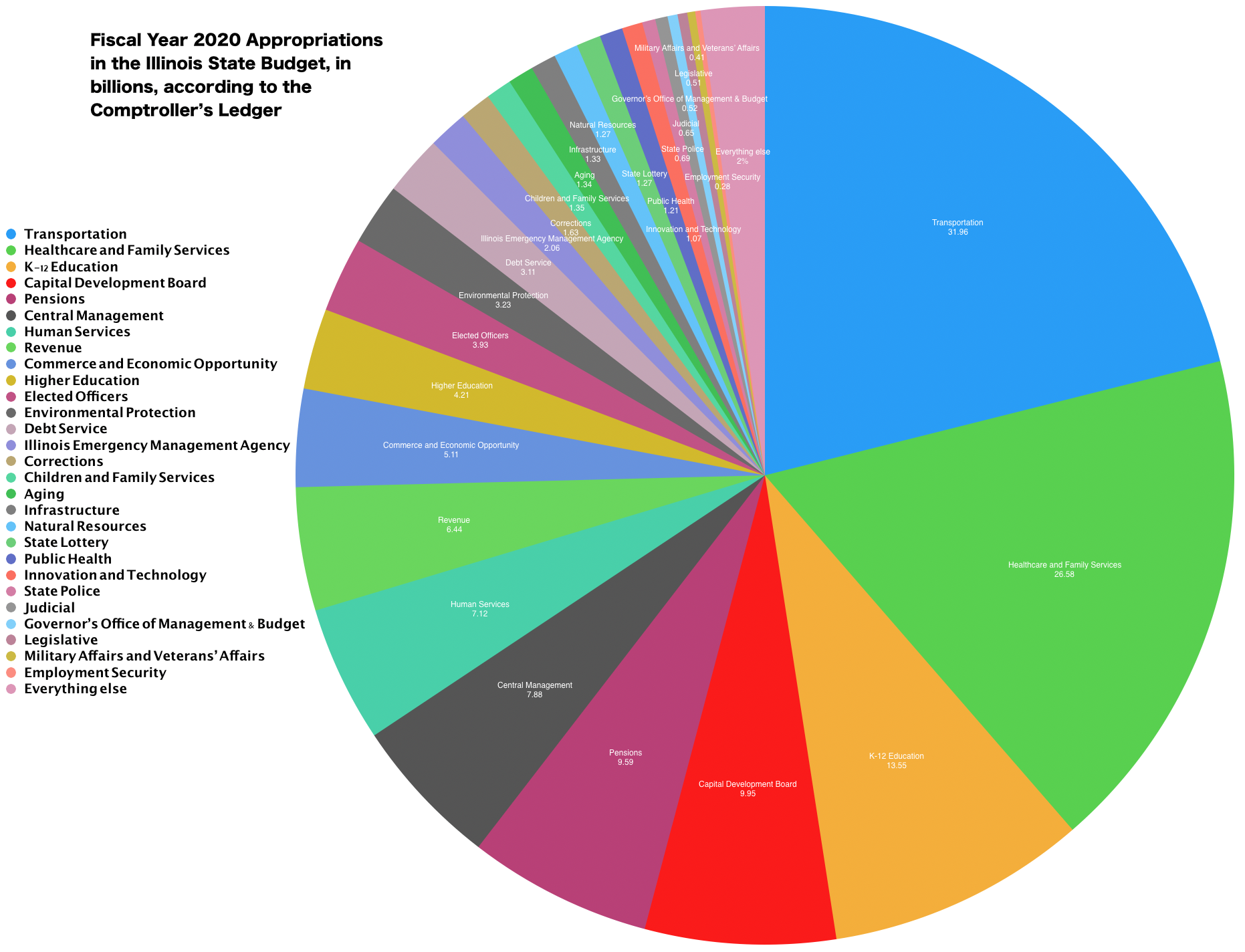
I’ve spent several hours studying the Illinois State Comptroller’s website.  It has not been designed in a way that helps the public understand the big picture of where money goes.  I have taken figures from the FY 2020 allocations to create this budget picture of state budget allocations:

A pie chart with many brightly colored slices representing allocations of public money in the Illinois State Budget.
The Illinois Public Outlays in FY2020

I think this chart is based on outlays that include money that is not raised through Illinois revenue; that is, it represents state spending that comes from state sources and state spending that is allocations of federal dollars given to the state. So, other charts showing spending might only show spending of funds that are in general revenue funds or dedicated funds that accumulate from Illinois sources (like taxes on gasoline or marijuana, or fishing and hunting licenses, and so forth). 

Oddly enough, the Transportation budget was reported as being $32 billion, the largest item in the budget.  I think this was an exceptionally large amount, due to a capital improvement bill getting passed, so in normal years that would have been significantly less. Likewise, the capital development board had $9.6 billion appropriated to give out for construction projects and renovations. 

Healthcare and Family Services, which is mostly payments to doctors, hospitals, pharmacies, dentists, and so forth, made through health management organizations, using Medicaid funding (the state gets about half the money back from the Federal government in Medicaid spending), was the next largest item, and in years without a capital improvements act, it would be the largest item, at $26.6 billion.

K-12 Education was the third largest allocation from the state, at $13.55 billion.  There is also money raised at the local level through property taxes, so the state and local combined spending on education is much higher.

Illinois has not adequately funded pensions for state employees, but that is a priority now, and $9.6 billion was allocated for pensions.

Central Management had a budget of $7.88 billion.  Nothing on the Comptroller really explained that.  There needs to be more useful information for average citizens about some of the budget items.  I think the Comptroller ought to do a better job.

Human Services had a budget of $7.1 billion. Some of that is federal money that just passes through the state government, like Women and Infants and Children programs ($0.394 billion). One of the largest items in the Human Services budget is the $1.257 billion for Community Based Services for Persons with Developmental Disabilities and for Intermediate Care Facilities.  Mental health grants and program support were at $0.303 billion, but probably ought to be funded at over $1 billion.  Grants associated with Child Care Services were $0.402 billion. Those probably ought to be closer to $0.8 billion.

The Department of Revenue had appropriations of $6.44 billion, and much of that was in the form of tax refunds.  I think that would include the Illinois State Earned Income Tax Credit, but the Comptroller’s ledger didn't break that down.  

   Commerce and Economic Opportunity had $5.11 billion.  I hope much of that money goes to investments in low-income communities, or state investment in training people to start worker-owned cooperatives and other forms of democratic capitalism.

  Higher Education had allocations of $4.2 billion.  Not nearly enough.  It ought to be at least $6 billion, and probably much more even than that.

Environmental Protection had a budget of $3.23 billion.

Our state has not had a balanced budget in quite a while, and service on our debt cost the state $3.1 billion.

Children and Family Services (child protection services, foster care, adoptions, and that sort of thing) had appropriations of $1.35 billion.  Probably $1.5 billion is more like what we need.

Corrections had a budget of $1.6 billion, but that does not include the budgets for county and city jails, which probably had a similar cost, if not possibly more in aggregate, but that cost is paid by local sales and property taxes for the most part.  Still, the accusation that the “the state spends more on locking people up than educating them” is ridiculously false, as our state education budgets for K-12 and higher education are in excess of $17.7 billion before even factoring in local spending on schools and junior colleges.  Even if county and local jails cost twice-as-much as the state prison system, we would still only be spending $3.8 billion on locking people up. 

The Department on Aging only had appropriations of $1.3 billion.  That will need to go up as the state ages.

Elected Officers had a budget of $3.9 billion.  I do not understand what that represents.  I suppose it includes pensions as well as salaries for elected officers, but that is not just the governor and elected state officials (e.g., the Comptroller) plus all the members of the Illinois General Assembly, is it?  It must include their staff members as well, I suppose.  But, there is also a budget category for the legislature, and that is $0.5 billion ($500 million), which seems enough to pay for lots of legislative staff. 

The idea that we ought to de-fund the police to support mental health services and alternative approaches to non-violent and nuisance crimes may make sense at the level of local budgets in cities and counties, but at the level of the state government, Illinois puts up $69 million for the State Police.  While I think mental health services should be increased substantially, I do not think the money required to meet our needs could be found in a budget item that is only $69 million, when we need $1,500 million more for mental health and substance abuse prevention/treatment, in my opinion.

Anyway, that is an overview of the appropriations for the State of Illinois budget as it was last year (FY 2020 ended on June 30 of 2020, and we are now in FY 2021).  If these numbers are wrong, blame Susana A. Mendoza, our Comptroller. She may not think it is the duty of her office to explain the budget or give the public reports that show how the state spends its money so that common people can understand it (I have a doctorate and have studied public policy and economics, and even I was confused by the information on the website). Perhaps that is what the Treasurer or the Governor should do.  I often rely on people like the staff at the Center for Tax and Budget Accountability to explain the budget.  Rich Miller and Charlie Wheeler also help us understand.

Tuesday, April 26, 2016

MAP grants are not getting adequate funding


For my second reaction paper, I will be discussing my feelings on the lack of MAP Grant funding in Illinois for the 2016-2017 school year.  The 2016-2017 school year is supposed to be the year I graduate with a Bachelor’s Degree in Social Work.  As a MAP Grant recipient, I am absolutely terrified that, because of the budget impasse in Illinois, MAP Grants will not be funded for the next school year. 

The Senate, House, and Governor Rauner have yet to come to an agreement on a state budget as of this writing.  Because of this, many social service agencies have closed, countless people have become unemployed, public universities are in jeopardy of shutting down without funding. It would be easy to construct a vast list of other negative effects of the budget impasse.  It is my understanding that Governor Rauner has proposed a state budget that would ultimately give him the ability to decide to move money around to different services as he deems necessary.  Of course, the House and Senate will not agree to this as giving control to Governor Rauner removes their own control of the state’s money allocation.  

Many attempts have been made to create a budget that is a suitable compromise for the branches of government previously listed.  However, each of these proposals have been rejected, still leaving us without a budget nearly nine months into the fiscal year.  While I had been following the budget crisis, it had not personally affected me until Governor Rauner vetoed a bill to fund MAP Grants.  

I have no idea if I will be able to finish my schooling next year.  I do not feel comfortable taking out even more students loans than I currently have to finish paying for my schooling when loans will most likely be necessary to pay for my master’s degree that I plan to enroll in after graduating from UIS.  I work at a job that I cannot afford to pay my bills without working overtime. I am not complaining about this; I just do not want to have to do this for the rest of my life.  

After Rauner vetoed the bill, a veto override failed by a mere two votes.  Now, instead of working on new proposals for the state budget, lawmakers are on “break”.  How many employers do you know that allow their employees to take an extended break when their primary job duties have not been fulfilled? It is absurd to me!  If MAP Grants are not funded, thousands of students will not be able to attend school next year, leaving universities with fewer students and less revenue.  Community colleges are funded through the MAP Grant and will be at risk of closing as well. 

Yes, I understand MAP Grants cost the state government a large amount of money.  However, MAP Grants are an investment.  MAP Grants allow students, such as myself, who would not otherwise be able to afford it, to attend college and earn a degree.  Degrees are crucial to obtaining a job that a person can live comfortably on.  If there are less college graduates (or even less universities to attend), who will fill the positions that require a college degree?  Would less qualified people be filling these positions?  Having under qualified employees in degree-required positions could lead to problems with companies’ productivity and profits.  The list can go on and on for negative effects caused by MAP Grants not being funded. 

Lawmakers need to get back to work from their vacation and come to an agreement on a budget, and make sure that budget funds higher education.  Higher education is a critical part to America’s economy.  I have already written about this topic to Governor Rauner and my Representative, Sara Wojcicki Jimenez, explaining my personal situation and the great impact that no funding for MAP Grants would cause to not only myself, but the entire state (and eventually even further).

I am glad you have written to Sara, our Representative in the General Assembly.
According to the Illinois Student Assistance Commission, the funding for MAP grants in FY 2014 was about $372 million, and about 136,000 students received aid.  Another 160,000 eligible applications for MAP funding were turned down for assistance due to lack of funding, so clearly this policy could reach full power if it were funded at about $800 million per year.

Keeping our state spending at levels we had in FY 2014 and 2015 would create a tremendous deficit, because the temporary increase in the flat income tax went away at the beginning of 2015.  I think there is a structural deficit of about $6.5 billion between what the General Assembly wants to spend and the revenue it takes in with taxes.  We could extend income taxes to retirement income over $50,000 per year and take in over a billion.  We could raise the flat income tax to 5% and increase standard deductions to make it a less burdensome tax to low-income persons and raise another $4 billion or so.  We could add a sales tax to many services and raise another $1 billion.  We might even be able to cut a few hundred million by encouraging greater efficiency in some state agencies or in higher education, or by legalizing marijuana and taxing it.  We could also probably survive a cut in spending of a billion or two billion.  At any rate, it would be possible to get rid of the state’s structural deficit by raising some taxes and cutting some spending.

However, as things stand now, the Republicans say they will not support new taxes.  The Democrats say they will not raise taxes unless some Republicans cross over to vote for higher taxes.  The Governor says he will not support any net increase in taxes (increase in revenue) unless his “Turnaround Agenda” is passed, and at least three of the five items on that agenda will never be passed by the General Assembly so long as Democrats hold majorities in it.  This is the nature of the impasse.  If Democrats would raise taxes without insisting on Republicans going along with them, and then would override the Governor’s veto, we could get a state budget.  However, a couple (or at least one) of the Democrats in the General Assembly won’t go along with that.  If some Republicans would cross over and present a mix of tax increases and budget cuts they could support, and then vote along with Democrats to override the Governor’s inevitable veto, that could also get us out of the budget stalemate.  If the Governor gave up on his turn-around agenda and worked with the Democrats in the General Assembly to create a compromise budget with a mix of spending cuts and tax increases, and left aside his turn-around agenda for the time being, that would also solve the problem.  The Democrats could also give up and just let the Governor do whatever he wants, and that would get us a budget, but the Democrats won’t do that.

Will the Governor give up and compromise with the Democrats?  If you think that this could happen, you ought to continue putting pressure on the Governor?  Will some Republicans cross over to work with the Democrats to create a budget and a plan for some spending cuts and some revenue increases (new or higher taxes)?  If you think this is plausible, you ought to be talking with Republicans in the General Assembly, so it is a very good thing that you have been communicating with Sara.

Some sorts of public spending works like investments to increase long-term growth.  MAP grants are exactly that sort of spending.  MAP grants really ought to be funded at $800 million per year in Illinois, and it is a travesty that they are not.  

Thursday, April 7, 2011

Illinois General Revenue Spending in Fiscal Year 2011

I was just looking at the expenses report from the Illinois Comptroller, and I made this pie chart to show some projections of where the state's general revenue fund money is being spent in FY 2011.