Monday, December 14, 2020

A student is horrified by treatment of undocumented immigrant children


The treatment of immigrants coming to the US from South America has been vile and disturbing for a very long time in America. However, with this most recent presidency, I feel it has reached a peak with how terrible it has been. 


While I was attending Lincoln Land Community College, in one of my classes there was a debate occurring and the topic was illegal immigration. This discussion/ debate began because this was right around the time that two children died within ICE custody, and it was a big news topic. One of the students in my class stated that it was not “our” (I’m assuming he meant the country’s or maybe ICE’s) job to keep these children alive, and that if their parents really wanted a better life for their children, they wouldn’t have crossed the border illegally. To know that this individual thought this way, and believed in this logic so strongly that he was willing to say it aloud, absolutely astonished me. He was discussing human life, a child’s life, that was taken because of our country’s negligence, and truly believed that the child’s death was within reason. 


To further this astonishment, I watched on TV as a Justice Department Lawyer argued that the children in ICE detention centers should not be entitled to soap, toothbrushes, or blankets while in their custody. The federal government was arguing to not give these human beings such important necessities including soap. This presidential administration has completely dehumanized these immigrants and this thought process obviously has spread to some of the American people, such as the boy in my LLCC class. 


In 2019, the US held a record number of migrant children in its custody. Nearly 70,000 children of immigrants were kept within US custody in 2019, which is more than any other country in the world. (AP News). It is an embarrassment to this country that we are so wealthy yet refuse to treat immigrants like human beings, because we disapprove of how they got here. To further the embarrassment, the president continues to go on live TV spewing hateful rhetoric towards those in South America, most famously claiming that Mexicans are rapists and criminals. 


We have to do better for our Latinx brothers and sisters, which includes making a lot of policy change. I believe one of the most important policy changes that needs to happen is making the process of becoming a US citizen more accessible, faster, and easier to navigate. I also believe enabling an easier process of renewing visas would help with those who become undocumented because of expired visas. These processes would allow immigrants who would like to come to America to easily become documented, lessening the need for ICE presence and detaining/ separating families. 


Link for Undocumented Children Statistics: https://apnews.com/article/015702afdb4d4fbf85cf5070cd2c6824


  I hoped the professor at Lincoln Land informed your class that the state does have a responsibility to keep persons who are in custody alive. In fact, the government does not have a duty to save the lives of citizens, unless the government has taken custody of citizens or foreigners (e.g., into state custody as children removed from parents or prisoners or detained undocumented immigrants). See the cases decided by the Supreme Court such as DeShaney vs. Winnebago and Town of Castle Rock vs. Gonzales, for the opinions.  Children apprehended and put in custody because they are undocumented foreigners absolutely are the responsibility of our government and ICE. 


  We should always be concerned when we see dehumanization.  When people dehumanize others, that is a step toward genocide.  All humans are born equal in dignity and rights. Dehumanization undermines our recognition of this fact.  When people start to describe others as vermin or cockroaches or rats, they are moving toward a call for the extermination of those others.  When people say that persons in detention do not deserve soap or blankets while is custody, they are moving toward the rejection of the humanity of those persons. 


Growing Up Poor In America

 Growing Up Poor In America

I loved every minute of this documentary [Frontline Season 2020 Episode 3]. I chose to write about this documentary for my reflection essay because as soon as COVID-19 spread I instantly wondered about the children that were already struggling. I think about the children whose only source of structure is school. Going to school everyday is some children’s only safe haven from their unstable households. 


    I wish I could do more to help these families. My heart broke for each family. I could not imagine going through those struggles as a child. I noticed that all 3 families had a running theme; they are all single mothers raising their children on their own. I feel for the mothers because it has to be a pretty awful feeling to not be able and support your children. I am not yet a parent but I imagine you would want to give everything you possibly can to your children. It would be heartbreaking to watch your children go hungry and not get an education that they deserve. The poorer neighborhoods often do not get as good funding for the children in attendance. 


    I grew up in a small town and my school did not adequately prepare me for my future in the slightest. However, I know that it still could have been worse. The family’s story that touched me the most was Shawn’s. I cannot believe how mature and grown up he acted for his age, it was so impressive. In a way it is sad because he feels he has to act that way because of his situation, so essentially he got his childhood robbed from him. He is such a good big brother to his baby sister and he helped his mom out whenever he could. I actually cried for him when he found out his favorite teacher passed away. This family has a trailer of their own and got some government assistance for food and bills. The mother just has to keep working at the Salvation Army in order to keep her benefits rolling in. 


    Kaila and Kyah do not even have a home to call their own. The documentary did not specify where they were living. They are all living with someone in one bedroom to the 3 of them. Their mom had a job lined up until COVID-19 hit. She was able to get some assistance because of that; but it just had not kicked in yet. They took advantage of their local food pantry as well as food stamps, so they did not go hungry. I really liked how Kyah said that “nobody wishes to be poor. Even though it may seem like it, it just means they accepted it.” Both girls seemed very wise for their age, most likely because they had to grow up faster than most kids due to their home life. The daughters seemed very grateful for what they had, even though it was obvious they wished they had more. It was hard to hear how they are already struggling with depression at such a young age. 


    Depression was also a running theme. Every child mentioned the feeling of overwhelming sadness or helplessness. Laikyn and Miracle also had a home that was theirs. Their mother had a job at a gas station and got some government assistance. It just is not enough to realistically support three people. She seemed to know exactly how to stretch it to get the most out of it and make it last the whole month. Laikyn was struggling very much with school due to ADD. I can attest how difficult it is for these kids to do school while not in their normal routines. I work at a daycare and virtual learning just does not work for most children. I understand that it is what must be done, but it definitely does not provide an ideal learning environment. 


    Miracle wanted to break the cycle and be the first in her family to go to college. I just do not think she comprehends how difficult that will be. I hope she buckles down and does it to get the life she deserves and wants. All of these families were just handed bad cards. Each mother was willing and wanting to work in order to provide for their children. It is not an issue of laziness but an issue of policies and the pandemic. We need more and better policies for these families but to get that we need better funding. These children are wasted potential because they know how to work harder than most and they have big dreams. How can we help them? 

A reflection on sex education

 I am passionate about comprehensive sex education in schools, and often talk about it. Sex education in school itself is already a controversial and uncomfortable conversation, but why? I believe the conversation about sex education should not be uncomfortable, but obviously will be when talking to elementary-aged children. Besides comprehensive sex education, there is also the other option which is abstinence-based education. The main difference between the two is that one talks about many different aspects of sex education and focuses on the education and safe practices while the other option puts abstinence as the main focal point to not have sex. The two different approaches are still being debated on whether sex education should be provided and if so, what method will they be teaching? This conversation is an important one, which is why I am talking about it today. 

Comprehensive sex education is an education program that talks about multiple aspects of sex. When the average person thinks about sex, you usually think of a consensual act done between a male and a female. Even though this is the typical scenario, there are many people who do not experience that. Comprehensive sex education would start in the beginning of elementary school which is why many parents do not support this approach. The point to starting so early is to educate young children on appropriate terminology of body parts and the difference between good touch and bad touch. This basically is trying to protect young children against getting hurt and being afraid to tell someone about it. In many child sexual abuse cases, the perpetrator often uses pet names or “cute” names for body parts. When a child uses these names to detectives or even their parents, it often gets skewed and is more difficult to determine. Starting comprehensive sex education at an early age could educate children to look for certain things and how to communicate. 

Abstinence-only sex education has a main focal point which is abstinence. In many examples of abstinence-only education, the education does not start until eighth grade. Unfortunately, the education seems to happen too late because a lot of children are already going through puberty. Besides that, the only education you receive is that you should wait until marriage to have sex and about sexually transmitted diseases. The education that is provided about waiting until marriage for sex usually consists of an abstinence pledge and scaring children about the horrors of getting pregnant and the consequences of unintended pregnancies. After getting scared about having sex, then the abstinence-only educators show graphic images of STDs and talk about the road to curing these. Abstinence-only sex education only focuses on the negatives of sex and does not think of the real-world. 

In my experience, my high school did abstinence-based sex education. It started in ninth grade, and the educator fit all into one semester. In the one semester, we covered an abstinence pledge, STDs, and contraception. I was surprised that we covered more than just condoms and talked about their effectiveness. While I was taking it, I did not think much about it. Now looking back, it was not the best and makes sense why it does not work.


Unwanted pregnancies are a problem, and we need good programs that prevent these, especially among younger persons.  Being pressured into sex and being psychologically coerced into pushing relationships in a sexual direction is another problem.  And, of course, sexually transmitted diseases are a terrible problem. So, you would imagine that our society would honestly try to find the sort of educational interventions that are most effective at preventing these things, and then implement those.  Since our society leaves decisions about educational content largely to local school district boards and principals and teachers, there is little or state governments and the federal government to do. The federal government can give grants to states or local school districts that implement approved programs, and deny grant money to school districts that defy federal or state recommendations, but that is the main way we get policy set in this area.

It has been years (over a decade) since I reviewed the evidence for abstinence only sex education (which is not at all what I received in middle school in 1979-1982). It was not the most effective intervention for preventing onset of sexual behavior or intercourse. It had an effect, and it seemed to mainly work by helping a minority of kids take on a sort of self-concept of themselves as being different from the mainstream, and this “specialness” was part of what helped them delay sex. The sex education I received in public schools was all about the plumbing and biology and so forth.  I still remember the question I asked as a sixth or seventh grader after one of the sessions of sex education (which I had mainly learned as a 6-year-old and 7-year-old at home).  I asked about what percentage of the time when a man ejaculated inside during ovulation would the egg be fertilized and develop into a baby?  I guessed it could not possibly be 100%, but wondered if it was something like 20% or 50% or 75% or what.  I don’t think my teacher knew the answer.  Come to think of it, I still don’t know the answer. I have been interested in miscarriages and natural pregnancy terminations (our third son died of a miscarriage before he was born), and so I know that a very high percentage of fertilizations do not end in a live birth.  It seems in many cases, the zygote only develops to the blastula stage (if it even gets that far) and gets flushed out with menstrual blood before the mother ever guesses she was “pregnant”, and was she pregnant? Does one become pregnant when one has a fertilized egg inside, or should we define pregnancy as starting around the 14th to 21st day (Carnegie stage 6 or 7), when the embryo really starts to take form in the uterine lining?  

  The more important questions of the role of sex in relationships, how to deal with sexual desire, how to be respectful of the wishes of others, and how to deal with jealousy, or sexual self-concept, or sexual orientation, or gender identity, or any of those very important topics, was ignored.  And, also, I think even in progressive American schools it would be rare to teach important lessons about how to give sexual satisfaction to partners, how to have a satisfying sex life, and how to avoid sexual infidelity or understand why people cheat, and things of that nature. Sexual complaints are a huge factor in marital dissatisfaction, and sexual infidelity contributes to many divorces.  I believe these sorts of things have been taught in public schools in the UK, Scandinavia, France, etc., but not so much in America.


Student is disturbed by police brutality

 Police Brutality has been on my mind for quite a long time. Minority groups are being targeted the most when it comes to these issues, and yet America finds it as an issue within’ the group and not the police. After watching Frontline: Policing the Police 2020, 

I can’t stop thinking about how this really has been going on for a lifetime and not just as a 2020 thing. I knew discrimination existed towards the minority groups because it’s been going on everyday and even if it’s not being seen, it’s happening somewhere, whether it’s in America or another country, it’s happening. It got a lot more serious this year because of George Floyd, but no matter what, there is still no justice. 


Can we go back in time for a minute? I know this doesn’t have anything to do with police, but if we look at the Emmitt Till case, the two men who beat him, they didn’t get sentenced to life; they didn’t get charged; and yet later, we find out that the woman died? That’s injustice right there. [Carolyn Bryant Donham, who made a false accusation against Emmitt Till, did not die (she could still be alive, for all I know)]


If we look at Rodney King, he got beat by police officers and why? If we look at Oscar Grant, where is his justice? We have so many people in this world who deal with police brutality, and I honestly could name them, but it’ll take up my whole paper. I have a friend who died because of Police Brutality. His story didn’t make it worldwide, but my city was truly hurt when this occurred, living in Peoria, we would never think such a thing would happen and it did. 


I honestly didn’t know Newark, New Jersey was dealing with such a tremendous Police Brutality, and when something was finally going to be done to stop it, Donald Trump said “no.” He really said that Police Officers should not be careful when putting “criminals” in the car and then the people dressed in military clothes in the background clapping proudly. That is definitely not okay and if they think it’s okay, it’s because they’ll never know how it feels to be a minority in those types of situations. I know this is supposed to be Police Brutality, but I’m just expressing how I feel overall about these types of situations. 


I don’t think this will ever end just because our country is being led by a President who doesn’t really care about anyone, except for those that are on his level. The election is giving me hope that Joe Biden hopefully does find a way to stop these Police Brutalities, but if Trump wins again, there most likely won’t be any changes and it will end up getting worse. 


I have had conversations with friends and students in law enforcement, and family members who have been in law enforcement, and with criminologists who are friends.  I think that we are devoting a lot of resources to a system of justice and police and corrections that should be protecting us and making us safe, but it is not really doing this effectively or efficiently.  I am not sure that reforms will be able to solve the problem. I think my cousin George Ives addressed this well over a hundred years ago when he pointed to the fact that too few people really want to understand why crime occurs and then create systems to prevent crime.  Most people are happier to create and sustain a system devoted to finding persons who commit crime and then punishing them. This is a devastating decision, because we could save far more money and lives by putting more resources into preventing crime, rather than putting so much into the system we have now.  And yet, I do not know how we will make the transition. 


I agree with your perception that there is a widespread and deep problem of police and prosecutors being unfair. It is worth acknowledging that there are many good people in law enforcement who are well-intentioned and doing the best they can, but making that observation does not really help move us toward a solution to the problem at hand; that our overall policing and prosecution and corrections system is failing us. 


It is probably also just hair-splitting to point out that many abuses by police that are attributed to racism are probably more centrally caused by brutality and a general disregard for the rights of citizens in the police officers.  That is, many police may be just as likely, or perhaps even more likely, to kill white Americans than African-Americans. This is argued by some who say that there are far more police interactions with African-Americans, largely because police mainly interact with poor persons, and African-Americans have a higher poverty rate (18.8% compared to 9.1% for white Americans). I think this argument as been rebutted by Ulrich Schimmack and Rickard Carlsson’s analysis of fatal use of force against non-suicidal young men who are not mentally ill (lots of fatal use of force by police against white Americans involves police killing older guys who are suicidal or suffering from serious mental illness). They have confirmed that police officers are more likely to shoot younger Black men who are non-suicidal and not suffering from a mental illness. And yet, there are some serious debates about how much we can attribute police use of force to racism and how much we can attribute to the sort of bad policing and police brutality that we could all be subject to, regardless of our race. I know there are many studies where criminal attributes and crime attributes have been controlled, and these show that judges and juries and prosecutors all give out harsher sentences to Black Americans compared to white Americans. It is difficult to argue against those facts.  But, if we are facing two serious problems: widespread bad policing and widespread prejudices in law enforcement workers and prosecutors, then do we really need to argue much about which is worse or which problem needs to be addressed first?  Both problems are serious, and both need to be addressed immediately.


For psychological reasons, I do not think Donald Trump would have been interested in transforming our law-enforcement system.  His father instilled so much anger in him, that the retribution and punishment model of approaching the world seems highly central to his core values. Biden may be different, but I wonder at this ability, or the ability of his Vice President, to bring together an alliance of criminologists, law enforcement professionals, mayors, and leadership in the Department of Justice to give us the revolution in our approach to crime that could significantly improve the situation.  I fear we are stuck with incremental reforms that are unlikely to make substantial changes.  


How to Help the Homeless

 There are many homeless people around the Springfield area. According to a WICS report, at one given time there are at least 271 homeless people in Springfield. [the January 2020 point-in-time census of persons living in emergency/transitional shelter and unsheltered counted 294 homeless persons in Sangamon County]  It seems that at almost every major intersection there is an individual a sign asking for help. I will sometimes give cash but it is not something I can do every time. So I did some research to see what other things can be done to help those experiencing homelessness without giving money all the time. I found there are several different ways we can help. The number one thing we can do as a community is contact our legislatures and demand that they do something to help the homeless.  There is no reason we should have any homeless people. I myself am not sure what the answer is but there has to be something we can all do. There are many buildings and homes just sitting empty that we should somehow be able to utilize to provide temporary housing to individuals.  Most would rather not be homeless and for some reason or another have fallen upon hard times and need help temporarily. Until something is done to help the homeless get back on their feet there are several more things we can do as community members to help make their life a little easier.

  • Smile, make eye contact and talk to them and get to know them and their story. Human contact is one of the most basic needs that we all need and can give. They might just want someone to talk to.
  • Offer to help in anyway you can. Offer food, water, personal items and if needed, cash. We really don’t know someone else’s story and they know what they need at the moment.
  • Call the Homeless Hotline if there is one available. In Springfield you can contact Ministries Emergency Shelter at 217-753-3939. There are several others too. 
  • If the person appears to be in distress see if you can get them an ambulance
  • Educate yourself on the homeless.

[To learn about what you can do, and follow the homelessness issue in Springfield, I recommend the website of the Heartland Continuum of Care at https://heartlandcontinuum.com/]

Something I am going to do is start carrying bags with me that has personal items in it, a list of shelters in Springfield and a small gift card to a restaurant where they can get a meal. 

Helping the current homeless population would only be the beginning, we also need to prevent it from  continuing to happen. We need to have services in place that are available to anyone before they become homeless.  Some of those services would be:

  • Have affordable housing available to provide to someone that will become homeless
  • Have other services available such as job training, provided daycare so parents can actively look for work
  • Intervention/Prevention programs to help financially 
The homeless population is growing and will continue to grow in the future for different reason. Many people have lost their jobs due to the pandemic, businesses have closed and people can’t  afford to pay their house payment or rent. We have to do something.  We live in a country that is rich in resources and we should be able to provide affordable housing so no one has to be homeless. 


This is a great reaction essay with a sharp focus on a single issue and an orientation toward solutions.  

The coordinator of the Heartland Continuum of Care was recently asked what would be most helpful, and he was also asked what is preventing us from solving the problem, since we do know how to solve the homelessness problem, as you have outlined in your reaction essay.  He said we lack resources.  Specifically, to move to a housing-first model for everyone, and a permanent supportive housing model for those who need that (which is probably all homeless persons with substance addictions or mental illnesses or co-morbid conditions, which is probably about 40% of all who become homeless in a year, and probably well over half of all who are homeless at any given point-in-time).  In either case, we need housing units where we can permanently place people, and we don't have enough of those.  The Landlord Association is willing to work with the Heartland Continuum of Care and make many units available, but we need more, and once those units are available, we need the money to pay the rent for those places. Could churches, the city government, the current homeless shelters (Helping Hands, Contact Ministries, Inner City mission, etc.) take on new roles as "landlords" for persons in permanent supportive housing or just supportive housing?  In any event, the point is that we do not have the resource: neither do we have funds to provide the rents or acquire the properties we need to house all the homeless, nor do we have the funding to pay the salaries of the persons who would provide wrap-around support and sobriety support and mental health services, or those who would coordinate the volunteers, who would be checking in with people in permanent supportive housing. 

The implication is that we ought to:

Push the city government and the 20+ entities in the Heartland Continuum of Care and the local religious congregations that help support the various services for the homeless to unify in applications for city, state, and federal aid to help us get the resources to supply housing and services for permanent supportive housing.


Support the efforts of Mayor Langfelder and the City Council to allocate more money to addressing the problems of Springfield residents who lack housing. 

Give money to whatever entity is collecting all the resources and coordinating the project of getting all this housing available, and to the services and shelters that currently feed and house the homeless when they run out of their SNAP benefits or monthly assistance—if they even receive those benefits (e.g., St. John's Breadline, Fifth Street Renaissance, the Salvation Army, Helping Hands, Contact Ministries, Inner City Mission, Central Illinois Food Bank, etc.).

Advocate for things that will prevent homelessness:
 affordable housing, 
more housing choice vouchers, 
rules forcing landlords to accept clients who use housing choice vouchers, 
more public housing units, 
more state-or-city equivalents of the federal public housing program, 
more subsidies and laws (especially zoning law modifications) that would create more affordable housing and land trusts, and distribute such housing equitably around a metropolitan area. 

Promote an understanding of housing as a human right.

Promote an understanding that it probably saves money (for hospital emergency rooms, local business owners, police departments, local jails) if persons experiencing homelessness are housed in permanent housing rather than put in transitional or emergency shelters, or left unsheltered.  Since the costs of police and local businesses and local hospitals are passed on to all of us in higher taxes and higher insurance premiums and higher prices in stores, we're paying for homelessness either way, and it just makes more sense to take care of this issue in the way that costs the least (providing permanent housing to everyone) while also meeting our obligations to see that everyone's human rights are protected.


As for the panhandlers, I would never give them money.  If someone comes to me and asks for help, I would usually refer them to Fifth Street Renaissance for breakfast and St. John's Breadline for lunch. Men could seek housing at the Helping Hands shelter or the Warming Shelter (in winter), and women could also seek shelter at Contact Ministries. The shelters typically provide dinner.  Give money or food to the shelters, so they can provide the meals to the 50-60 persons who eat dinner each night. I ask persons who work at the food banks, the homeless shelters, and the Fifth Street Renaissance about the panhandlers at the intersections with their cardboard signs, and they say they don't recognize those persons as clients. I expect that it's a difficult life to work as a panhandler and stand at intersections with a sign asking for money for food, and I expect only desperate people would seek their income in that line of work, so I understand why your sympathies and compassion might lead you to give them something. I just would rather give money to the entities that are providing direct services to persons who are really homeless while also working to solve the problem of homelessness in our community.


Wednesday, November 11, 2020

Student strongly opposes current immigration detention practices

 Immigration has been occurring since the beginning of time. Everyone residing in the United States, besides Native Americans, all have immigrated. In today’s world immigration is seen as this horrendous act, and this perception honestly upsets me. There have been immigration detention camps where authorities separated children from their families. Literally, breaking families apart. Before this anti-immigrant viewpoint was dominant, families were able to stick together. It degrades America’s reputation when so many in our society perceive immigration as such an awful and dangerous thing. 

Separating families is really sickening, and that’s what America is constantly doing. Why do supporters of this policy think these people deserve such treatment? Yes, they came to America illegally, but that does not mean that our border guards should make the children suffer and be afraid because they don’t know when or if they’ll ever reconnect with their families.  American authorities could at least provide them with some essential care. We are in a pandemic and we are not doing much to protect those detained children. According to ice.gov, ICE focuses on smart immigration enforcement, preventing terrorism and combating the illegal movement of people and trade. If that’s the case, they should not have to separate these families. If their jobs are to prevent immigration, then they should keep the families together. 


According to the ICE website, “ICE is committed to ensuring that those in our custody reside in safe, secure, and human environments and under appropriate conditions of confinement.” Just a couple of weeks ago, news broke out that those detained in these detention camps were undergoing unnecessary gynecological surgeries including full hysterectomies. That should show people, and the world, that the persons running these detention facilities are taking cruel advantage of the detainees. They have no right to perform such surgeries with the detainees unless the detainees themselves have agreed to do so, but even that brings problems, because someone may be lying to the detainees and telling them that something else will be done, when in result this is what is occurring. 


The Netflix documentary called Immigration Nation, came out this year, and it gives us a better insight on how ICE approaches immigrants. That documentary brought tears to my eyes because I witnessed men crying due to the fact that they were separated from their children and they were not reconnected with them until days, months later, not knowing where they were at and with who. These detainees were lied to, being told they were going somewhere to reconnect, but in reality, they were going to a prison. I recommend that Netflix documentary, because it shows these peoples’ true colors. It upset me when one of the ICE officers took a picture of one of the detainees, sent the picture to his “buddies” and laughed at him. That was so inappropriate and disturbing to watch. The Trump Administration feel like they are doing something, but they are really affecting these children, young children. 


Overall, I understand on the issues that The USA tries to do to prevent people from immigrating, but there needs to be a better solution. No family should be separated. I feel for these people because they are my people and it could happen to my family to anyone. Immigration has been here since the start of time and if back then they were able to work things out, I am positively sure something good could also come back out of this, but separating families should not be a punishment for people who want a better life. Being treated poorly and being performed surgeries at these detention camps should not be occurring. Trying to better and be there for these people should matter. 

This is a strongly-felt reaction essay to a real problem. Social workers have core values related to social justice and the dignity and worth of the individual, and we also are committed to promoting good human relationships. There is one issue where reasonable persons disagree: how many immigrants should be allowed to come to the United States, and what criteria should be considered when deciding whom to allow here? The issue addressed here is a separate one, asking how we treat persons who come here without appropriate documentation, or fail to leave here when their allowed time here has expired. The basic assumption most people would make is that such persons ought to be returned to their home countries, or to the countries from which they have arrived. But, the principles of human rights compel us to provide protection and security to persons who are fleeing persecution or threats to their lives (according to Articles 3 and 14 in the Universal Declaration of Human Rights), so there should be exception to the general rule of expelling such persons.  


There might also be good reason to allow some non-citizens who have long resided in the United States as undocumented residents to remain her and perhaps become citizens; if they have been productive members of society, never committed serious crimes, and have lived her so long that culturally they have become Americanized, it would have in fact, if not in law, become Americans (in the cultural, not the legal sense), and depriving them of living here as Americans would be a sort of deprivation of their adopted nationality (a violation of Article 15 of the Universal Declaration of Human Rights).  I'm starting with a premise that shared life experiences and real human relationships create reality, and the state and its laws and those who enforce its laws are a sort of secondary and artificial social construct that has a purpose of protecting our rights and facilitating conditions in which we can flourish and depend on enforcement of justice. If laws create situations of unfairness and injustice, and thwart human flourishing and inflict misery, then rather than simply break those laws, it would be better to amend or replace them. Leaving bad laws in place and breaking them can create lawless situations, and it is better to make good or better laws to replace those that seem to produce evil conditions.


The issue of family separation is one of these evil conditions. Children should remain with their parents (Articles 12, 16, 25, and 26 of the Universal Declaration of Human Rights all imply this, I think).  It is also a bad thing to imprison minors with adults. So, while it make sense that adults and minors should not be detained or imprisoned together, there clearly must be an exception for parents with children. And in fact, if people have a reasonable expectation that they will suffer in their country of origin, I think they ought to be allowed to roam freely in America, and not detained. We need a system that can quickly determine whether persons have realistic fears, and if they do, they should be offered asylum or assistance in setting up a new life somewhere safe (e.g., Queretaro, Guanajuato, Hidalgo, Tlaxcala, Tabasco, Oaxaca, Belize, Costa Rica, Panama) 


Americans who want to block those immigrants from living here could probably make a case that they should seek refuge in the first safe country they arrive in, and not wait until they cross to the USA to seek refuge.  For example, if Guatemala, Honduras, and El Salvador are all so violent and chaotic that a person is not save in any of those countries, persons fleeing from those lands should be encouraged to seek refuge in Nicaragua, Belize, Mexico, Costa Rica, or Panama before coming to the USA. 


Some people have suggested that when children were apprehended by ICE agents, their parents were not with them, and persons who claimed to be their parents were in fact kidnappers or child human traffickers who only pretended to be parents. If there are any cases where this was so, those would be cases where children would end up I detention apart from their parents, but we could not blame ICE for such a situation. Also, the accusations against the gynecologist in Georgia who allegedly performed unwanted and unnecessary surgeries has not been settled, and the doctor and prison, as you point out, claims the accusations are unfair.  I certainly am inclined to believe the 17 women (or is it more?) who have made the accusations, but until the situation is thoroughly investigated, I cannot really know what happened.  What I do know is that the conditions in which the detained persons are being held are violating their human rights.  As those persons are in the custody of the United States, we all are responsible for the conditions in which they are held.  They are clearly not being shown respect for the dignity of their person, or their worth.  They are not receiving adequate medical care, and since they are in our care, we have a duty to provide such care to them. Further, our immigration processes are unfair and unjust, and people live here (in detention or not in detention) in a state of uncertainty and doubt while they wait for immigration authorities to make determinations on their claims or their appeals. The waiting time is very longer and during the wait these people are in a precarious state.  As you say, there are many outrageous and disgusting aspects of how we (our government) is treating these people, and we must push our government to improve the immigration process and the detention conditions.

Monday, October 19, 2020

The Budget of the State of Illinois


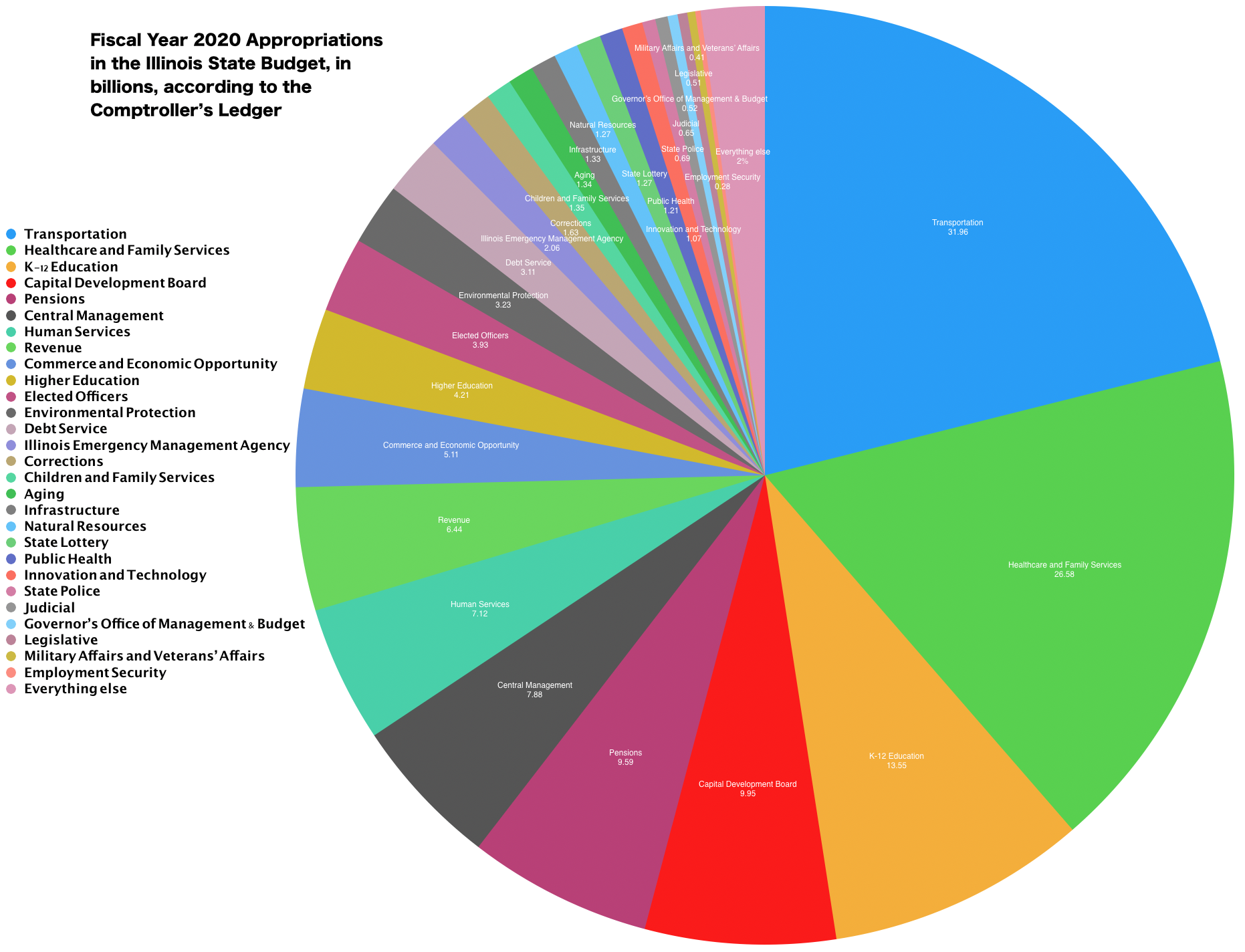
I’ve spent several hours studying the Illinois State Comptroller’s website.  It has not been designed in a way that helps the public understand the big picture of where money goes.  I have taken figures from the FY 2020 allocations to create this budget picture of state budget allocations:

A pie chart with many brightly colored slices representing allocations of public money in the Illinois State Budget.
The Illinois Public Outlays in FY2020

I think this chart is based on outlays that include money that is not raised through Illinois revenue; that is, it represents state spending that comes from state sources and state spending that is allocations of federal dollars given to the state. So, other charts showing spending might only show spending of funds that are in general revenue funds or dedicated funds that accumulate from Illinois sources (like taxes on gasoline or marijuana, or fishing and hunting licenses, and so forth). 

Oddly enough, the Transportation budget was reported as being $32 billion, the largest item in the budget.  I think this was an exceptionally large amount, due to a capital improvement bill getting passed, so in normal years that would have been significantly less. Likewise, the capital development board had $9.6 billion appropriated to give out for construction projects and renovations. 

Healthcare and Family Services, which is mostly payments to doctors, hospitals, pharmacies, dentists, and so forth, made through health management organizations, using Medicaid funding (the state gets about half the money back from the Federal government in Medicaid spending), was the next largest item, and in years without a capital improvements act, it would be the largest item, at $26.6 billion.

K-12 Education was the third largest allocation from the state, at $13.55 billion.  There is also money raised at the local level through property taxes, so the state and local combined spending on education is much higher.

Illinois has not adequately funded pensions for state employees, but that is a priority now, and $9.6 billion was allocated for pensions.

Central Management had a budget of $7.88 billion.  Nothing on the Comptroller really explained that.  There needs to be more useful information for average citizens about some of the budget items.  I think the Comptroller ought to do a better job.

Human Services had a budget of $7.1 billion. Some of that is federal money that just passes through the state government, like Women and Infants and Children programs ($0.394 billion). One of the largest items in the Human Services budget is the $1.257 billion for Community Based Services for Persons with Developmental Disabilities and for Intermediate Care Facilities.  Mental health grants and program support were at $0.303 billion, but probably ought to be funded at over $1 billion.  Grants associated with Child Care Services were $0.402 billion. Those probably ought to be closer to $0.8 billion.

The Department of Revenue had appropriations of $6.44 billion, and much of that was in the form of tax refunds.  I think that would include the Illinois State Earned Income Tax Credit, but the Comptroller’s ledger didn't break that down.  

   Commerce and Economic Opportunity had $5.11 billion.  I hope much of that money goes to investments in low-income communities, or state investment in training people to start worker-owned cooperatives and other forms of democratic capitalism.

  Higher Education had allocations of $4.2 billion.  Not nearly enough.  It ought to be at least $6 billion, and probably much more even than that.

Environmental Protection had a budget of $3.23 billion.

Our state has not had a balanced budget in quite a while, and service on our debt cost the state $3.1 billion.

Children and Family Services (child protection services, foster care, adoptions, and that sort of thing) had appropriations of $1.35 billion.  Probably $1.5 billion is more like what we need.

Corrections had a budget of $1.6 billion, but that does not include the budgets for county and city jails, which probably had a similar cost, if not possibly more in aggregate, but that cost is paid by local sales and property taxes for the most part.  Still, the accusation that the “the state spends more on locking people up than educating them” is ridiculously false, as our state education budgets for K-12 and higher education are in excess of $17.7 billion before even factoring in local spending on schools and junior colleges.  Even if county and local jails cost twice-as-much as the state prison system, we would still only be spending $3.8 billion on locking people up. 

The Department on Aging only had appropriations of $1.3 billion.  That will need to go up as the state ages.

Elected Officers had a budget of $3.9 billion.  I do not understand what that represents.  I suppose it includes pensions as well as salaries for elected officers, but that is not just the governor and elected state officials (e.g., the Comptroller) plus all the members of the Illinois General Assembly, is it?  It must include their staff members as well, I suppose.  But, there is also a budget category for the legislature, and that is $0.5 billion ($500 million), which seems enough to pay for lots of legislative staff. 

The idea that we ought to de-fund the police to support mental health services and alternative approaches to non-violent and nuisance crimes may make sense at the level of local budgets in cities and counties, but at the level of the state government, Illinois puts up $69 million for the State Police.  While I think mental health services should be increased substantially, I do not think the money required to meet our needs could be found in a budget item that is only $69 million, when we need $1,500 million more for mental health and substance abuse prevention/treatment, in my opinion.

Anyway, that is an overview of the appropriations for the State of Illinois budget as it was last year (FY 2020 ended on June 30 of 2020, and we are now in FY 2021).  If these numbers are wrong, blame Susana A. Mendoza, our Comptroller. She may not think it is the duty of her office to explain the budget or give the public reports that show how the state spends its money so that common people can understand it (I have a doctorate and have studied public policy and economics, and even I was confused by the information on the website). Perhaps that is what the Treasurer or the Governor should do.  I often rely on people like the staff at the Center for Tax and Budget Accountability to explain the budget.  Rich Miller and Charlie Wheeler also help us understand.